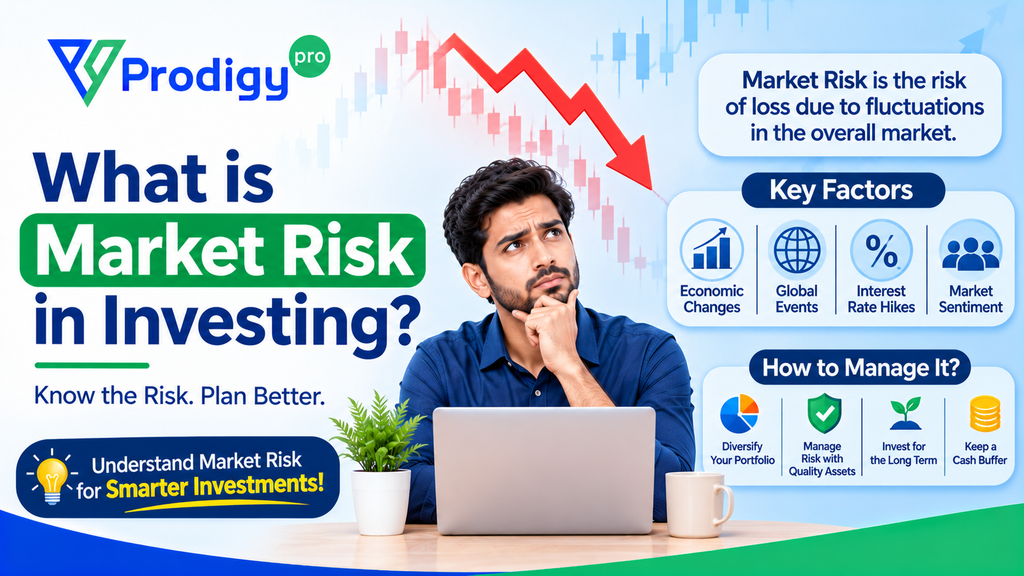
Market Risk
Market risk is a critical factor affecting the value of your financial portfolio in the constantly changing world of investing. This poses the risk that the value of your investments might fluctuate with changing market drivers like the economy, interest rates, political events, and global matters, which are driven by a spike in investment volatility, gauging how rapidly and dramatically values can rise and fall.
In this blog, we will explore what market risk is, what factors affect it, and how it can be managed. The knowledge of market risk empowers investors to analyse investment opportunities, develop sound strategies, and manage the intricacies of financial markets.
Market Risk: What You Need to Know About Volatility
Market risk is the risk that the value of your investments will rise and fall based on fluctuations in the economy, interest rates, or other variables. This creates concern for investors as it makes their investments less predictable.
So when we say “investment volatility,” we mean how much and how quickly investment values change. Volatility is the range of an asset’s price over a specific period of time for ex. – 1 year, 5 years and 7 years. High volatility usually only occurs when prices move wildly quickly, while low volatility occurs when prices remain stable and change slowly. By knowing what volatility is, investors can evaluate risk to determine whether they should buy or sell their investments.
Investors must understand the risk factors, stay up to date on market developments, and take precautions against possible losses to reduce risk. This could involve increasing their exposure and establishing specific financial goals, such as saving for retirement, a child’s education, or using market instruments to reduce risk, etc.
Market risk prepares investors to choose wisely and adjust to market volatility.
Top Key Methods and Metrics for Measuring Market Risk
- Value at Risk (VaR): This metric provides an estimate of the maximum potential loss an investment could experience over a given time in normal market conditions. For example, if a portfolio’s VaR is ₹75,000 at a 95% confidence level, the portfolio will not lose over ₹75,000 in a day with 95% confidence.
- Standard Deviation: This metric measures how much an investment’s returns deviate from its average return. A higher standard deviation indicates greater volatility, which means the investment carries a higher level of risk.
- Beta: The beta lets you know the volatility of an investment relative to the Indian stock market. Beta is a measure of risk that tells an investor how much risk they are assuming for the expected return; a beta of 1 means the investment moves with the market, a beta greater than 1 suggests more volatility than the market, and a beta less than 1 means less risk than the market.
- Stress Testing: A strategy that measures the performance of an investment or a portfolio in extreme market conditions in the Indian market. Investors can then gauge how their portfolios might have been affected by simulating different environments, such as large economic changes or political events.
- Scenario analysis: Scenario analysis is the evaluation of hypothetical situations (for example, currency fluctuations or changes in government policy) based on their possible impact on asset values in the Indian environment.
Types of Market Risk
Market risk is classified into different types based on the sources of possible losses in the Indian financial market:
- Equity Risk: This type of risk refers to the loss that occurs due to stock price movements on Indian exchanges, which are influenced by factors such as company performance, investor sentiment, and market trends.
- Interest Rate Risk: This one is specifically for bonds and fixed-income investments in India. This risk relates to the movement of the interest rates decided by the Reserve Bank of India (RBI). Interest rates and the prices of existing bonds generally move in the opposite direction, so when rates rise, the values of bonds usually decline, which can lead to losses for investors.
- Currency Risk (Foreign Exchange Risk): Includes the risks from fluctuations in exchange rates when investing in foreign securities or assets. For example, a reduction in the value of the Indian Rupee (INR) compared with a given currency can reduce overall profit when swapped back into INR.
- Commodity Risk — In India, commodity-based risk is the risk of an increase or decrease in the prices of commodities like oil, gold, and agricultural products. Many factors can influence the price of commodities, such as domestic supply and demand, global market trends, and geopolitical stability.
- Liquidity Risk: When investors are not able to transact quickly on an asset without causing a major drop in its price, they face liquidity risk.
This knowledge can help investors navigate the complexity of India’s financial markets and make informed investment choices.
Key Factors Influencing Market Risk
- Economic Conditions: Generally, in a growing economy, young businesses thrive, and stock prices rise. In contrast, prices may decline in a recession.
- Interest Rates: Rising interest rates increase the cost of borrowing, likely hindering economic growth and harming investments.
- Inflation: Inflation erodes the purchasing power of money, reducing its value over time. It can also increase businesses’ operating costs, affecting their profitability and potentially putting downward pressure on stock prices.
- Political Events: Unforeseen government policy changes or elections that cause instability can affect investors.
- Global Events: Dark-horse events like natural disasters, pandemics, or geopolitical tensions can have a serious impact on international markets and make investors rethink their strategies.
Mitigating Market Risk: Strategies for Investors Facing Volatility
- Diversification is a key strategy in managing market risk. By investing in various asset classes, such as stocks, bonds, and real estate, investors can create a safety net. This strategy ensures that if one area goes down, the others may not, providing a sense of security.
- Staying up to date with the current macroeconomic trends is crucial for investors, as this helps them make better investment choices and feel more confident in their financial decisions.
- Understand your financial goal before making any investment decision; it helps you stay focused and not panic during market downturns.
- Utilise Stop-Loss Orders. This mechanism automatically sells your investment when its price falls to a certain level, minimising losses to some extent.
- Have some cash available for unexpected expenses. This will prevent you from selling your investments during a downturn.
- Consult with financial advisors who can offer personalised assistance.
Also, Check – Fiscal Deficit Explained.
On a parting note…
Once again, market risk is an essential part of investing. Due to the volatile nature of financial markets, active investments must be managed. However, by understanding factors affecting market risk—economic conditions, interest rates, inflation, political events, and global events—investors can mitigate certain level or risks.
Please share your thoughts on this post by leaving a reply in the comments section. Contact us via phone, WhatsApp, or email to learn more about mutual funds, or visit our website, Prodigy Pro. Alternatively, you can download the Prodigy Pro app to start investing today!