Investing is one of the most powerful ways to grow wealth over time. But with countless options competing for your attention, choosing where to put your money can feel less like investing and more like picking from a very long menu.
Whether you’re a seasoned investor or just getting started, understanding the different types of investments—and the risks, returns, and advantages that come with each—is essential. After all, your money deserves more than a random pick.
This guide breaks down 7 types of investments, ranks them based on key factors, and explains each in simple terms, with relatable examples to help you understand where they fit into your financial journey.
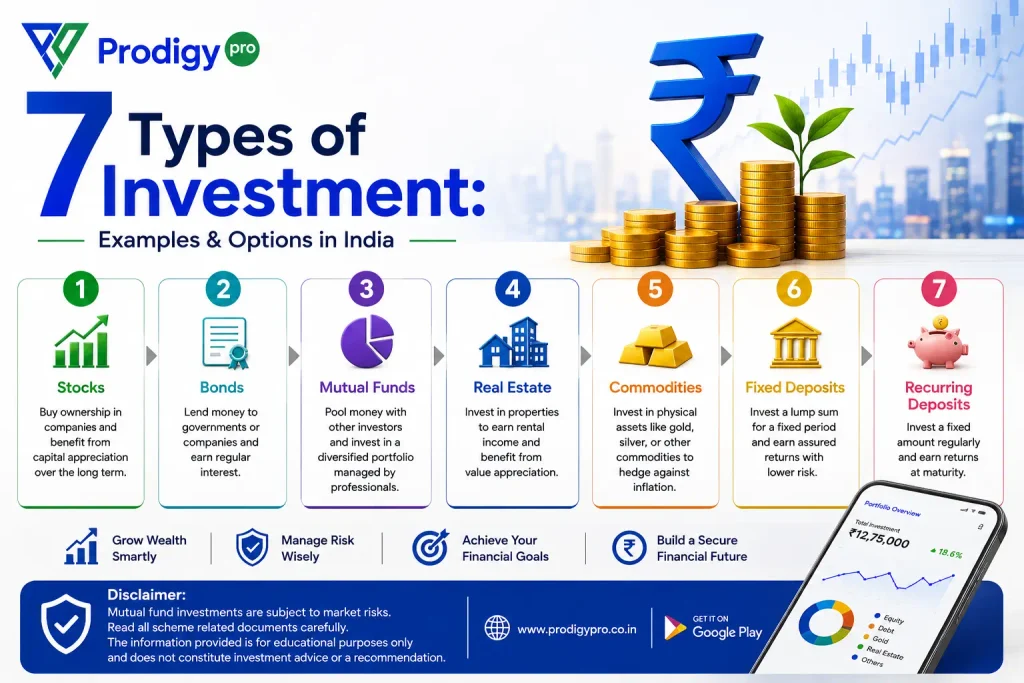
7 Types of Investments
From stocks and bonds to mutual funds and real estate, you can put your money to work in different ways. Each comes with its own mix of risks, returns, and potential rewards, so the right choice ultimately depends on your financial goals, time horizon, and comfort with risk.
1. Stocks
Stocks are the most popular form of investment. Buying a stock means buying a small ownership stake in a company. Think of it as owning a tiny slice of a very large pie. If the company performs well, its stock price may rise, allowing you to sell at a profit. If things don’t go as planned, the stock price can fall too, which means your investment could lose value.
For example, suppose you buy 10 shares at ₹1,000 each, investing ₹10,000 in total. If the share price rises to ₹1,500, your investment would be worth ₹15,000, giving you a ₹5,000 profit if you sell. But if the price falls to ₹500, your investment would be worth just ₹5,000, resulting in a ₹5,000 loss if you sell.
Stocks can be volatile, with prices moving significantly over relatively short periods. That makes diversification and sensible risk management important parts of building a stock portfolio. After all, putting all your eggs in one basket is rarely a great investment strategy.
2. Bonds
If stocks feel a little too much like a roller coaster, bonds can offer a relatively calmer ride. When you buy a bond, you’re essentially lending money to a government or company in return for periodic interest payments and the repayment of your principal after a specified period.
Bonds are generally considered less risky than stocks and can offer more predictable returns. However, they aren’t completely risk-free—there’s always the possibility that the borrower may fail to make interest or principal payments.
Example: Suppose you buy a government bond worth ₹10,000 that pays 5% interest annually. You would receive ₹500 in interest each year until the bond matures, say after 10 years. At maturity, you would typically receive your original ₹10,000 back.
Bonds can be particularly useful for investors looking for relatively stable income and can also play an important role in diversifying a portfolio and balancing the higher volatility of equity investments.
3. Mutual Funds
Mutual funds are investment vehicles that pool money from multiple investors and invest it across a mix of assets such as stocks, bonds, or other securities. In simple terms, instead of picking and managing every investment yourself, you can invest in a professionally managed portfolio.
A fund manager takes care of selecting, monitoring, and managing the investments based on the fund’s objective. This also gives investors the benefit of diversification without having to buy individual stocks or bonds themselves.
For example, suppose you have ₹50,000 to invest but aren’t sure which stocks to pick. Instead of putting the entire amount into a few individual companies, you could invest in a mutual fund that spreads your money across several companies and sectors, such as technology, healthcare, and energy. So, if one sector has a bad day, your entire portfolio doesn’t necessarily have to join the party.
This combination of professional management and diversification makes mutual funds a popular choice for investors who want exposure to multiple securities without having to actively manage each investment themselves.
4. Real Estate
People invest in real estate by buying property, be it land, houses, or commercial retail space, expecting its value to appreciate over time. Real estate is less liquid than stocks but provides opportunities for passive income in the form of rent.
For example: you buy an offshore property worth ₹50 lakhs in a growing area. On appreciation of the property value over the years, you sell it for ₹70 lakhs, thus making a profit of ₹20 lakhs. However, renting the property fetches monthly rental income.
5. Commodities
Investing in commodities means buying physical products, such as gold or silver. High inflation usually implies that commodities would perform well and serve as an inflation hedge. Commodities can be purchased directly or through commodity-focused funds.
For example: If you buy gold worth ₹5 lakh and inflation inflates the price of gold, the investment goes up. Usually, prices of gold surge in uncertain economic situations, which means it is a good well for diversifying your portfolio.
These might be subject to high price volatility in an international market and, in some cases, provide good tax-saving investments if held for a long period.
6. Fixed Deposits (FDS)
Fixed deposits (FDs) have long been the peaceful corner of the investment world. You deposit a lump sum with a bank for a pre-agreed period, ranging from a few months to several years, and earn interest at a predetermined rate.
FDs generally offer higher returns than a regular savings account, while typically carrying lower risk and offering more predictable returns than market-linked investments. The trade-off? Their returns are usually more modest than what you may potentially earn from investments such as stocks.
In short, FDs may not be the most exciting investment in the room, but they can offer something many investors value: stability and predictability.
Example: You put ₹1 lakh in an FD for 3 years at the rate of interest of 6% per annum. At the end of the tenure, you would receive ₹1 lakh along with ₹18,000 interest, totalling ₹1.18 lakh.
FDs are beneficial for conservative investors wanting guaranteed returns. A large portion of financial planning, especially for people who wish for short-term investments with guaranteed returns, revolves around such investments.
7. Recurring Deposits (RDs)
Recurring deposits (RDs) are much like fixed deposits, except that instead of a single, lump-sum amount, you deposit a fixed amount every month for a specific period. After the completion of the term, the principal amount plus interest is paid to the investor.
For example, you would invest ₹5000 each month in an RD for three years with an interest rate of 7%. At the end of the period, you will receive the interest earned, along with your ₹1.8 lakh investment. These deposits are pretty good for those who cannot invest a huge lump sum but wish to invest slowly over a period of time.
Also, Check – SIP vs Step-Up SIP: Which Investment Strategy Builds Wealth Faster?
Conclusion
Investing can be a powerful path to wealth creation, but there’s no one-size-fits-all approach. From stocks, bonds, and mutual funds to real estate, commodities, fixed deposits, and recurring deposits, each investment avenue comes with its own mix of potential returns, risks, and purpose.
The key is not to chase every investment under the sun, but to build a portfolio that aligns with your financial goals, time horizon, and risk appetite. Diversification can help spread risk, while understanding what you’re investing in can help you avoid costly surprises.
Whether your goal is capital appreciation, generating passive income, or saving taxes, let your financial objectives—not the latest investment fad—drive your choices. After all, the best portfolio isn’t the one with everything in it; it’s the one that makes sense for you.
Please share your thoughts on this post by leaving a reply in the comments section. Contact us via phone, WhatsApp, or email to learn more about mutual funds, or visit our website. Alternatively, you can download the Prodigy Pro app to start investing today!
Disclaimer – This article is for educational purposes only and does not intend to substitute expert guidance. Mutual fund investments are subject to market risks. Please read the scheme-related document carefully before investing.