Mutual funds in India started back in 1963 with the launch of UTI MF. The objective was to provide comfort to investors who are not equipped enough to track and compare thousands of stocks and their performances.
Since then, the industry has only grown rapidly under SEBI’s watch, offering a wide range of investment options for all!
Today, this industry has expanded to include:
45+ AMCs.
1000+ schemes.
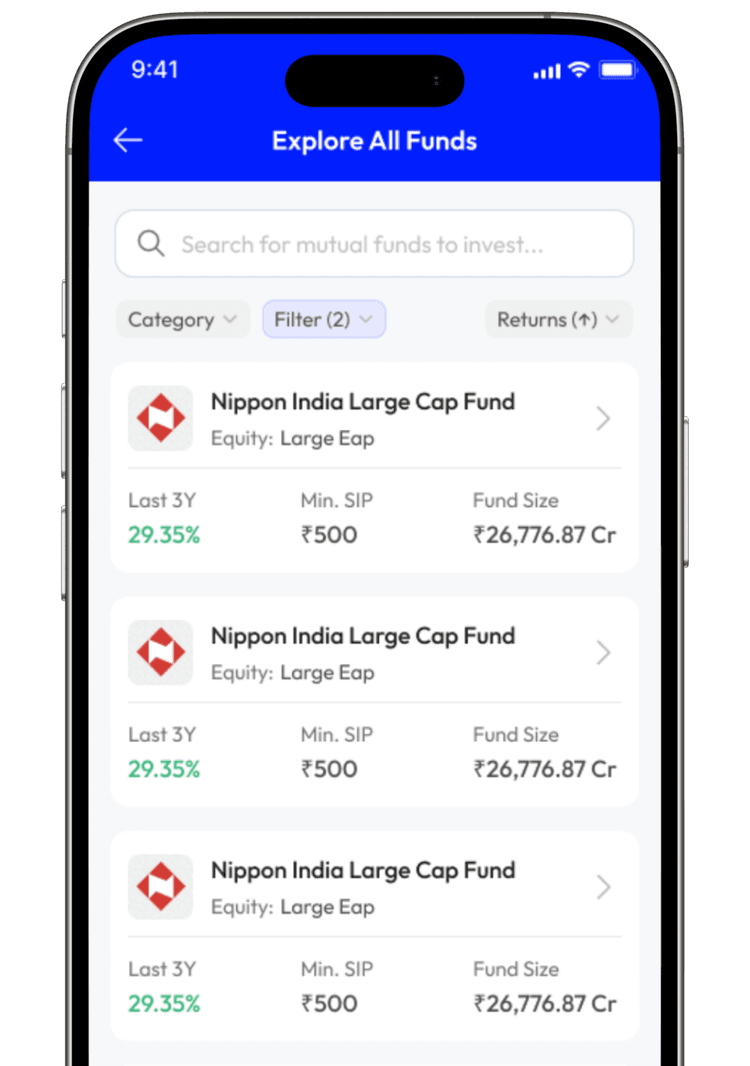
Discover mutual funds across all categories using the all mutual funds screener
Type
Category
Thirty years ago, mutual funds in India were still finding their place. That changed when SEBI stepped in during the late 90s, precisely in 1996, and started shaping the industry with strict rules, clear disclosures, and strong investor protection
Fast forward to July 2025, and the industry now manages a record ₹75.36 lakh crore of investor wealth, proving just how far it has come. What’s even more heartening is the rise of SIPs, where ordinary Indians invest a little every month with big dreams for the future. In July alone, SIP contributions touched a historic ₹28,464 crore, powered by over 9 crore active accounts. Behind these numbers are crores of families investing for their children’s education, a first home, retirement, or simply financial independence. Mutual funds have truly become the people’s way of building wealth in India.
A mutual fund is a specific investment product that is offered by an AMC or asset management company and is managed by an experienced fund manager who pools money from multiple investors and then invests it in a diversified portfolio of stocks, bonds, and/or other securities to enhance returns on the pooled capital and generate profits for investors.
Let’s break this down in a simple, real-life way.
Imagine four friends — Amit, Ravi, Neeraj, and Sameer. Amit is a lawyer, Ravi is a businessman, Neeraj works in a government job, and Sameer is a wealth manager. One day, the first three friends go to Sameer and say, “We’re not able to manage our money properly. Can you take care of it for us, and of course, charge a fee for your service?” Sameer agrees to invest their money wisely, balance risk and returns, and manage everything on their behalf. This, in simple terms, is exactly what a mutual fund does, i.e., A professional fund manager pools money from different investors and manages it for them in exchange for a small fee.
When you invest in a mutual fund, you’re not investing alone.
Here’s what really happens behind the scenes:
Mutual funds are run by a company called an AMC (Asset Management Company). Think of it as a financial institution that collects money from thousands of investors, i.e. people like you and me.
So instead of one person trying to buy a bunch of stocks or bonds individually, everyone’s money is pooled into one big fund.
The AMC appoints a professional fund manager, whose job is to invest that pooled money based on the objective of the scheme, whether it’s growth, income, capital protection, or something else.
They pick where to invest (stocks, bonds, gold, etc.), how much to allocate, and when to enter or exit those investments.
Now, here’s the catch: most people don’t talk about:
Once your money is invested, your returns depend on the market movement as well as the fund manager’s capabilities– so you should know that both factors are equally monumental in deciding your mutual fund returns.
Apart from capability and expertise, market movement.
For example:
Let’s say you invested when the mutual fund’s NAV (Net Asset Value) was ₹10 per unit. You bought 10,000 units, so:
Now, suppose the entire mutual fund scheme had a total AUM (assets under management) of ₹100 crores.
Three months later, the market does well and the value of the scheme rises to ₹120 crores. Since the total asset value increased, the NAV also goes up.
But what if the market didn’t perform and the scheme’s value dropped to ₹90 crores?
And remember that in both cases, the fund manager still charges a fee. That’s usually a small percentage, and it’s adjusted in the NAV itself.
Anyone, whether a salaried professional, student, retiree, business owner, housewife, or even a teenager, can invest in mutual funds after completing the mandated KYC formalities.
But…
There are some specific rules when it comes to NRIs (Non-Resident Indians) and certain other categories of investors. So while the doors are open to almost everyone, some categories like NRIs, PIOs, or foreign nationals may have a few extra checks or restrictions in place, depending on regulations and the fund house’s policy.
So, if you're a resident Indian with valid documents, you can start your mutual fund journey anytime. And if you're an NRI or fall into a special category, it's just about understanding the rules before you begin, and we're here to help you with that.
Investing in mutual funds is easy; you just need to follow the following steps:
Before You Begin
To invest in mutual funds, you’ll need:
1. Download the App
Search for “Prodigy Pro” on the Google Play Store or Apple App Store and install it.
2. KYC Validation
First,ensure that your KYC is completed and verified. If not, you can do it within the app itself using your PAN and Aadhaar. In case you are KYC compliant, you can easily sign up within the app.
3. Sign Up
Register using your mobile number and create a User ID & Password.
4. Create Your Profile on Prodigy Pro
Enter essential details like:
Start Investing
Once your profile is created and verified, you can begin exploring schemes, start a SIP or lump sum, and place transactions directly through the app.
Active Fund
Actively managed by fund managers aiming to outperform the benchmark. Fund selection is based on research and strategy.
Passive Fund
Tracks a specific market index and replicates its performance. These funds have lower costs and limited fund manager intervention.
Open-Ended Fund
You can invest or redeem anytime. These funds offer high liquidity and flexibility.
Close-Ended Fund
Has a fixed maturity period. Investments can be made only during the NFO period, but they can be traded on stock exchanges.
Interval Fund
Allows buying or selling only during specific time windows. A mixed structure combining features of open and closed-ended funds.
Growth Fund
Focuses on capital appreciation more. Ideal for long-term investors who can stay invested through market ups and downs.
Income Fund
Aims to provide a regular income through interest and dividend payouts. Suitable for conservative investors.
These mutual funds invest primarily in stocks, aiming for high returns and capital growth. These are best suited for long-term wealth creation.
Types of Equity funds:
1. Large Cap Fund:
Large Cap funds are mandated to invest at least 80% of their money in equity & equity-related instruments, primarily in the stocks of large, well-established companies with a high market capitalization.
2. Mid-Cap Funds:
Mid-Cap funds are mandated to invest at least 65% of their money in mid-cap stocks.
3. Small Cap Fund:
Small Cap Funds are mandated to invest at least 65% of their money in small-cap stocks.
4. Multi-Cap Fund:
Multi-cap funds are those funds that invest at least 25% of their money in large-cap stocks, 25% in mid-cap stocks, and 25% in small-cap stocks.
5. Thematic / Sector Funds:
These funds invest at least 80% investment in stocks of a particular sector/ theme.
6. Equity Linked Savings Scheme (ELSS):
Commonly known as tax-saver mutual funds, these schemes qualify for tax exemption under Section 80C of the Income Tax Act, 1961. Investors can claim a deduction of up to ₹1.5 lakh in a financial year by investing in ELSS. 80% of their money in equity stocks, along with a lock-in period of 3 years.
7. Index funds or ETFs:
These funds mimic the performance of a particular index and generate returns similar to the index being tracked.
8. Focused Funds:
These funds are focused on the number of stocks (maximum 30) with at least 65% in equity & equity-related instruments.
9. Value Funds:
These funds follow a Value investment strategy, with at least 65% in equity stocks.
10. Contra Funds:
These funds follow a contrarian investment strategy with at least 65% in stocks.
11. Dividend Yield Funds:
As per SEBI’s mutual fund categorisation, Dividend Yield Funds fall under the Equity Schemes category. These funds are mandated to invest at least 65% of their assets in equity and equity-related instruments, specifically focusing on dividend-yielding stocks. The objective is to generate returns by investing in companies with a consistent track record of paying dividends.
12. Flexi Cap funds:
Flexi Cap Funds are a part of the Equity Schemes category. These funds are required to invest a minimum of 65% of their total assets in equity and equity-related instruments, but unlike large-cap, mid-cap, or small-cap funds, they have complete flexibility to allocate investments across all market capitalisations.
13. Large and mid-cap funds:
Large & Mid Cap Funds are part of the Equity Schemes category. These funds are required to invest a minimum of 35% of total assets in large-cap companies (top 100 by market capitalisation) and a minimum of 35% in mid-cap companies (101st to 250th by market capitalisation).
Explore: Best Equity Mutual Fund to Invest in 2025
These mutual funds make investments in government securities, bonds, and other fixed-income securities. Compared to equity mutual funds, these funds are the best option for steady returns with less risk.
Types of Debt Funds:
1. Overnight Funds:
These funds invest in Overnight securities/ Securities having a maturity of 1 day.
2. Liquid Funds:
These funds invest in Debt and money market securities with a maturity of up to 91 days only.
3. Ultra Short Duration Funds:
These funds invest in Securities with a Macaulay duration of the portfolio between 3 months- 6 months.
4. Low Duration Funds:
These funds invest in Securities with a Macaulay duration of the portfolio between 6 months- 12 months.
5. Money Market Funds:
These funds invest in Money Market instruments having a maturity of up to 1 Year.
6. Short Duration Funds:
These funds invest in Securities with a Macaulay duration of 1 to 3 years.
7. Medium Duration Funds:
These funds invest in Securities with a Macaulay duration of the portfolio between 3 years- 4 years.
8. Medium to Long Duration Funds:
These funds invest in Securities with a Macaulay duration of the portfolio between 4 years- 7 years.
9. Long Duration Funds:
These funds invest in Securities with a Macaulay duration of the portfolio greater than 7 years.
10. Dynamic Bond Funds:
These funds do not have any restrictions on maturity profiles and have the flexibility to dynamically manage the portfolio across short-, medium-, and long-term debt instruments based on the interest rate outlook.
11. Corporate Bond Funds:
These funds keep a Minimum of 80% of their investment in corporate bonds only in AA+ and above-rated corporate bonds.
12. Credit Risk Funds:
These funds keep a Minimum of 65% of their investment in corporate bonds, only in AA and below-rated corporate bonds.
13. Banking and PSU Funds:
These funds keep a Minimum of 80% in Debt instruments of banks, Public Sector Undertakings, Public Financial Institutions, and Municipal Bonds.
14. Gilt Funds:These funds keep a Minimum of 80% of their investment in G-secs or government securities.
15. Gilt Funds with 10-year constant duration:
These funds keep a Minimum of 80% of their investment in G-secs, such that the Macaulay duration of the portfolio is equal to 10 years.
16. Floater Funds:
These funds keep a Minimum of 65% of their investment in floating rate instruments (including fixed rate instruments converted to floating rate exposures using swaps/ derivatives).
Explore: Best Debt Mutual Fund to Invest in 2025
These funds carry a mix of both equity and debt. They combine both equity and debt to balance risk and return. These funds are suitable for investors who can take moderate risk with a balanced approach.
Types of Hybrid funds:
1. Conservative Hybrid Funds:
These funds keep 10% to 25% of their investment in equity & equity-related instruments, and 75% to 90% in Debt instruments.
2. Balanced Hybrid Funds:
These funds keep 40% to 60% of their investment in equity & equity-related instruments, and 40% to 60% in Debt instruments.
3. Aggressive Hybrid Funds:
These funds keep 65% to 80% of their investment in equity & equity-related instruments, and 20% to 35% in Debt instruments.
4. Dynamic Asset Allocation or Balanced Advantage Funds:
These funds keep Investment in equity/ debt that is managed dynamically (0% to 100% in equity & equity-related instruments, and 0% to 100% in Debt instruments).
5. Multi-Asset Allocation Funds:
These funds keep Investment in at least 3 asset classes with a minimum allocation of at least 10% in each asset class.
6. Arbitrage Funds:
Arbitrage funds are hybrid mutual funds that generate returns by using the strategy of simultaneously buying and selling securities in different markets to take advantage of different prices.
7. Equity Savings Funds:
These funds keep investment in Equity and equity-related instruments (min.65%), Debt instruments (min.10%), and Derivatives.
Explore: Best Hybrid Mutual Fund to Invest in 2025
Professional Fund Management: You don’t need to track the stock market or read financial news daily. Professional fund managers take care of that—they research, strategise, and manage your money smartly.
Liquidity: Want to pause your investment? Switch to another fund? Withdraw part of your money? Most mutual funds allow that, without complicated lock-ins.
Returns: With rising prices, saving in a bank account or an FD may not be enough. Mutual funds have the potential to give better returns and keep your money growing faster than inflation.
Affordability: You don’t need to be rich to invest in mutual funds at all. Even if you’re starting small, a monthly SIP of ₹500 can put you on the path to long-term wealth creation. Whether you’re salaried, self-employed, a student, a homemaker, or retired, there’s a mutual fund suited to your goals and comfort with risk.
Diversification: Mutual funds don’t put all your money in one fund. They invest across different companies and sectors, which basically means that if one doesn’t perform well, others can help balance the impact.
Well-Regulated: In India, mutual funds are primarily regulated by SEBI, or the Securities and Exchange Board of India. SEBI oversees the entire mutual fund industry to ensure transparency, investor protection, and adherence to regulations.
Safe: Mutual funds are a safe investment option to begin with, as they are well-regulated and offer complete transparency in terms of where and how your money is being invested; however, they are not completely risk-free.
Risk: Mutual fund investments are not completely risk-free; they are, in fact, subject to market risks, which is why it is essential that you have a thorough understanding of your risk profile before making an investment decision.
Lock-In Period: Some Mutual Fund schemes, like ELSS, have a certain lock-in period before which you will not be able to withdraw money from your mutual fund.
Over diversification: Overdiversification in mutual funds means investing in too many similar schemes, leading to portfolio overlap and diluted returns. It adds complexity without significantly reducing risk, making it harder to track and manage your investments effectively.
SIP (Systematic Investment Plan): SIP is a mode of investing in mutual funds where you invest a fixed amount of money, at regular intervals, on a fixed date, which roughly means that you invest your money regularly at fixed intervals. You don’t need to time the market; you start small, and the emotional burden of investing disappears. It’s perfect for salaried individuals, businessmen, and even young adults just starting their careers.According to recent SEBI updates, now you can invest in SIP with as little as 250 rupees, which makes it affordable and attractive for beginner investors or first-time investors!
Lump sum: It is a way to invest in mutual funds where you invest a sum all at once in one go– lump sum investing is suitable for investors who have received a surplus amount of money, like bonuses, cash rewards, windfalls, or retirement benefits.
Investor Profile: First and foremost, you should have a good understanding of your risk profile, investment horizon, and your financial goals before investing in a mutual fund. These 3 things determine the kind of investor you would be and will help you pick suitable schemes.
Pro tip: If you face troubles while assessing your investor profile, you should always consult with a financial expert for better assistance.
Performance: You should be equally well-versed in comparing the performance of the various schemes.
Pro tip: Look beyond returns! Focus on consistent performance across market cycles!
Risk: Every fund carries risk, even debt funds. So you should know the volatility, credit risk, and interest rate sensitivity before choosing a scheme.
Pro tip: By increasing your investment horizon, you can mitigate your risk.
Lock in: Check if there’s a lock-in period (e.g., ELSS has 3 years). Some funds restrict withdrawals or levy exit loads for early redemptions.
Pro tip: before investing, always check your liquidity requirements.
Expense ratio: TER is the annual cost of managing a mutual fund, expressed as a % of its average AUM. It covers management fees, admin, and other expenses. Importantly, TER is already adjusted in the NAV, so the returns you see are net of expenses.
Pro tip: the TER of a particular scheme has no direct correlation with its performance.
Portfolio manager and the AMC: Check the track record of the fund manager and the credibility of the Asset Management Company (AMC).
Pro tip: Consistency matters more than fame.
Taxation: Be aware of capital gains tax (short-term and long-term) and dividend taxation, as they directly impact your post-tax returns.
Pro tip: Taxation in MFs has now become significantly complicated— consult with your financial expert before investing.
Professional advice: If you're unsure, seek guidance from a registered financial advisor to choose the right fund mix aligned with your needs and avoid emotional decisions.
Pro tip: Investment is more of an art than a science! Your behaviour during market fluctuations matters the most.
Following recent tax developments, ELSS, PPF, NPS, and other tax-saving schemes are no longer considered attractive for tax planning. Under the new tax regime, individuals already get the benefit of tax exemption up to ₹12 lakh (₹12.75 lakh for salaried individuals with a standard deduction of ₹75,000) without needing to invest in tax-saving instruments. Hence, these schemes do not provide any additional tax benefit and are not suggested purely for tax-saving, as they bear no incremental result.