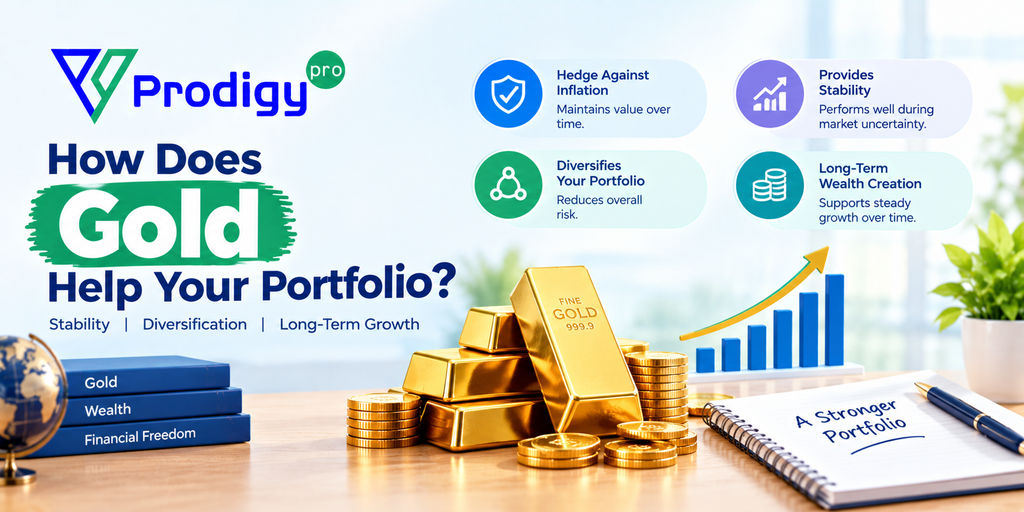
In an uncertain economic environment, investors are always looking for ways to protect their wealth while making it grow. While stocks, bonds, and real estate remain popular investment choices, gold has earned its place as a valuable part of a diversified portfolio. Beyond its historical association with wealth and security, gold offers several benefits that go beyond price appreciation.
This article explores how gold investment can strengthen your investment strategy, the role it plays in managing financial uncertainty, and why it deserves consideration as part of a well-balanced financial plan.
9 Key Benefits of Gold Investments For Your Portfolio
1. Diversification: Strengthening Portfolio Resilience
Diversification forms the backbone of a healthy investment strategy. It’s the process of spreading investments across multiple asset classes to reduce dependence on any particular fund. Gold plays an important role in portfolio diversification because of its low correlation with traditional asset classes such as stocks and bonds. This means its price movements do not always follow the same pattern as these investments. When stock markets experience a downturn or economic conditions become uncertain, gold investment may help balance portfolio performance.
Including gold in an investment portfolio can help spread risk, improve portfolio stability, and reduce overall exposure to market fluctuations.
2. Inflation Hedge: Upholding Purchasing Power
Gold can be used as an inflation hedge. Inflation steadily diminishes the money’s purchasing power. While fiat currency can lose value, gold can retain or even gain value during inflation.
History has consistently shown that rising inflation increases demand for gold. In the 1970s, a decade of rampant inflation, gold prices surged, proving it can preserve wealth. In effect, gold saves your money when other currencies do not.
3. Safe Haven: An Asylum In Times Of Uncertainty
People typically turn to gold during economic downturns, geopolitical instability, or global pandemics, as investors seek a safe, stable asset.
Unlike stocks, which can experience sharp price fluctuations, or real estate, which can take time to sell, gold is a widely recognised asset that can be relatively easy to buy and sell. Its value is not tied to the performance of any single government or financial system, making it an option investors often turn to during periods of uncertainty. In times of economic or geopolitical turmoil, gold investment can offer a sense of security and help balance the risks in an investment portfolio.
4. Risk Reduction: Cushioning Market Volatility
All investments come with some level of risk, but gold investment can help reduce overall portfolio risk. This is largely due to its low correlation with equities and other asset classes, meaning its price movements do not always follow the same direction as the stock market.
When stock prices fall, gold may hold its value or even gain, helping offset some of the losses in other investments. Including gold in a portfolio can therefore help manage market volatility, improve portfolio stability, and make it easier for investors to navigate uncertain market conditions.
5. Currency Hedge: Hedging Against Depreciation of Currency
With an increasingly interconnected global economy, foreign currencies are either directly or indirectly exposed to investors. A devalued local currency, like the Indian Rupee or even the U.S. Dollar, has a ripple effect on investments.
Gold serves as a hedge against currencies by preserving value irrespective of the fluctuations in currency strength. Because gold is valued in U.S. dollars worldwide, a weakening dollar usually pushes up gold prices, providing protection and equilibrium in currency-exposed investments.
6. Low Correlation: Maximising Efficiency
Gold complements other investments in a portfolio rather than competing with them. Including gold in a diversified portfolio can improve risk-adjusted returns by helping balance overall risk without necessarily requiring investors to take on additional risk to pursue better returns.
Modern portfolio theory validates this approach. Adding low-correlated assets such as gold enhances portfolio efficiency, particularly during periods of economic uncertainty.
7. Crisis Protection: Performing in Economic Downturns
Whether it’s a banking crisis, a recession, or political turmoil, gold investment has a proven track record of providing crisis protection. Unlike assets tied to government guarantees or corporate performance, gold trades independently, giving it a support-enhancing edge in times of adversity.
Investors who retained gold in their portfolios during the 2008 financial crisis or the 2020 COVID-19 crisis saw how gold not only retained value but even surged as markets plunged into panic. This resiliency adds an invaluable circle of protection to any investment portfolio.
8. Preservation of Wealth: Holding Value Through Generations
Over the centuries, gold has symbolised retaining wealth. Its value never depreciates over time like paper currency can be debased or inflated. Rather, gold has maintained its purchasing power over centuries and therefore is a stable store of wealth that endures through generations.
This is particularly useful for long-term investors and generational wealth planners. Whether held as physical or financial instruments, gold provides a well-tested method of keeping assets out of economic and political change.
9. Long-Term Store of Value: Planning for the Future
Compared to many short-term, speculative investments, gold is not a short-run store of value. It neither promises quick returns nor achieves consistent performance over decades. Investors wanting to build long-term portfolios that compound and endure should invest some of their capital in gold.
Its long-term popularity, global demand, and resistance to devaluation make gold an ideal ingredient for long-term financial planning, whether you’re saving for retirement, a child’s education, or long-term estate planning.
Final Thoughts
Gold is more than a shining metal; it’s an investment tool that plays a vital role in investment portfolios today. From diversification and risk management to currency hedging and a safe haven, gold brings balance, stability, and security to your financial future.
While inflation fears grow and world uncertainties persist, having gold in your investment portfolio can not only protect your funds but also strengthen your investment returns. Even if you choose to invest in gold sovereign bonds, ETFs, physical gold, or electronic gold, there’s one common aspect: gold is an interesting asset for any diversified investor.
Please share your thoughts on this post by leaving a reply in the comments section. Contact us via Phone, WhatsApp, or Email to learn more about mutual funds, or visit our website https://bfccapital.com/ .
Alternatively, you can download the Prodigy Pro app to start investing today!
Disclaimer – This article is for educational purposes only and does not intend to substitute expert guidance. Mutual fund investments are subject to market risks. Please read the scheme-related document carefully before investing.
Frequently Asked Questions (FAQs)
1. What’s the optimum share of gold in a portfolio?
Most experts recommend investing 5% to 10% of your whole portfolio in gold for optimal diversification and protection against risk.
2. Is gold better than stocks during a recession?
Gold investment does well during recessions as a safe haven, while stocks are risky and prone to economic downturns.
3. Can gold protect me from currency devaluation?
Yes, gold is a great hedge against currency devaluation, especially when local currencies lose value or inflation happens.
4. In what ways is physical gold distinct from gold ETFs?
Physical gold must be secured and stored but has the potential to provide actual value. Gold ETFs are liquid and easy to use but have ownership represented by paper contracts.
5. Does gold accrue interest or dividends?
No, it does not. Its value comes from capital appreciation and preservation of wealth in the long term.