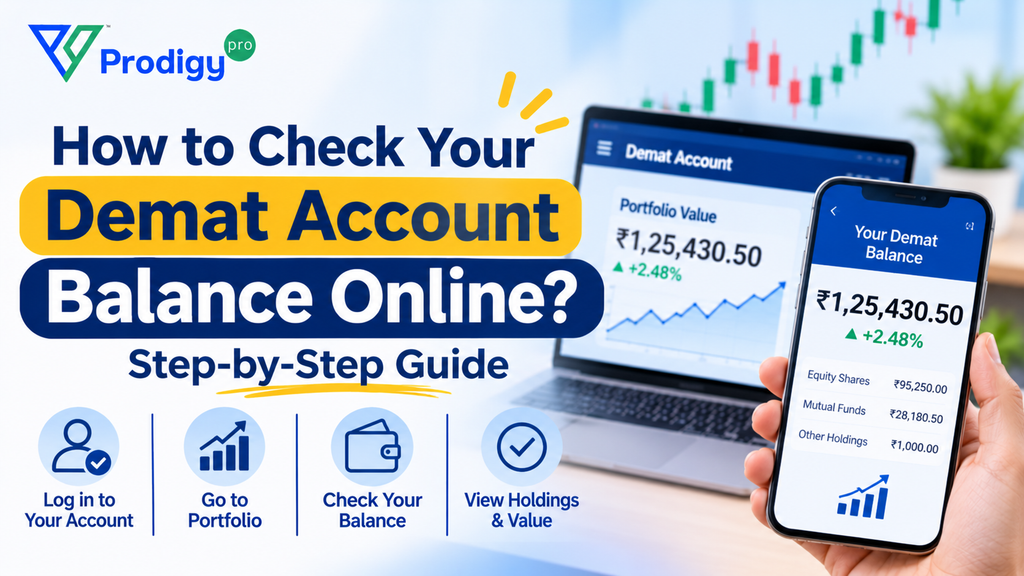
Demat accounts are necessary to hold securities in electronic format in today’s digitally driven investment landscape. As an established investor or someone new to the financial investment world, it is important to keep up with your financial investments. One of the most important things to do is check your Demat account balance online, as this will keep you informed about your financial assets, market performance and portfolio position.
This blog is your ultimate resource to learn what a Demat account balance is, how to check this information online and the importance of tracking a Demat account balance for effective portfolio management.
What Is a Demat Account Balance?
A Demat (Dematerialised) account is an account that allows investors to hold shares and securities in a digital format, as opposed to physical certificates. It operates similarly to a bank account, but rather than holding money, it trades in equity shares, bonds, ETFs, mutual funds and most other forms of securities.
A Demat account balance represents the quantity and value of your holdings, which include:
- Holdings Balance: Your current active investments on record.
- Transaction History: Buy/sell transactions.
- Free and Locked-in Securities: Shares, stocks or equity held available for trade and those under lock-in periods.
- Valuation: Real-time market value of your holdings
Checking this balance on a regular basis is important from both the perspective of ensuring no unauthorised transactions are occurring and tracking the performance of your portfolio.
How to Check Your Demat Account Balance Online
There are three methods to check your Demat account balance online:
Depository Portal (CDSL or NSDL)
India has two central depositories—NSDL (National Securities Depository Limited) and CDSL (Central Depository Services Limited). Each investor is registered under one of the two, even if they have registered on both via their Depository Participant (DP) or stockbroker.
For NSDL Account Holders:
You can check your NSDL Demat account via NSDL’s IDeAS portal.
Steps:
- Visit the NSDL IDeAS site.
- Click on ‘Beneficial Owner (BO) Login.’
- Choose the IDeAS option.
- Insert your User ID and Password (Note: you will need to sign up as a first-time user).
- Once you are logged in, you can navigate to ‘Holdings’ to see your balance.
Tip: NSDL can email you a consolidated account statement (CAS) that provides a summary of your holdings in each account.
For CDSL Account Holders
Your balance can be verified via CDSL’s Easi/Easiest portal.
Steps:
- Visit the CDSL Easi portal.
- Log in using your BO ID (16-digit demat account number), PAN and OTP.
- Select the ‘My Holdings’ tab, and you will see the securities you own and their valuations.
Tip: Please note that there is also the option to register for the CDSL Smart App, which can be downloaded on Android and iOS.
Via Your Broker’s Trading Platform
Most investors will open their Demat account through a stockbroker like Zerodha, Upstox, Angel One, Groww, ICICI Direct, HDFC Securities, etc.
These platforms combine both trading and Demat capabilities, allowing investors to buy and sell securities and view their account balances all from one application.
Steps:
- Log in to your Broker’s mobile app or web platform.
- Look for the ‘Holdings,’ ‘Portfolio,’ or ‘Demat Portfolio’ section.
- You will receive a comprehensive listing of your securities with your holding quantities and their current value.
- In addition, these platforms may provide additional functionality such as live tracking, P&L, alerts, custom reports, etc.
For example, in Zerodha’s Kite app, you can click on “Holdings” to see live valuations, average price, day change, P&L, etc.
Through Consolidated Account Statement (CAS).
The Consolidated Account Statement (CAS) is a single consolidated statement issued either monthly or quarterly to your registered email, which contains, as a summary, all investments held across mutual funds, equity shares, bonds, etc., which are registered across NSDL, CDSL and AMCs.
Steps:
- Visit NSDL’s CAS portal.
- Enter your PAN and DP credentials to request and/or receive your latest CAS statement.
- You can also use CAMS or KFinTech portals to download your CAS across AMCs.
The CAS statement is important as it provides an entire picture of your portfolio. It is particularly useful for long-term investors who operate or work with many platforms or brokers.
Benefits of Regularly Checking Your Demat Balance
- Investment Tracking: Monitor your portfolio performance and market trends.
- Security Monitoring: Identify unauthorizsd/suspicious transactions.
- Portfolio Rebalancing: Control your holdings by aligning with your financial goals and market conditions.
- Tax Planning: Monitor your portfolio capital gains and losses for proper tax filing.
- Simplicity of Reporting: Reporting your Demat account and the Demat balance across investments to banks/eventually for loan applications, income tax returns, and financial declarations.
Security Precautions
As needed when checking your Demat account online, the following security precautions should also be applied:
- Always use an official website/app.
- Enable two-factor authentication (2FA) on all broker platforms and apps.
- Log out after every session.
- Do not access sensitive financial information while using public Wi-Fi.
- Check the source of CAS emails to avoid phishing.
Conclusion
Making it a habit to check your Demat account balance regularly online is a good financial practice. It gives you an immediate, timely view of your financial position, enhances transparency and allows you to make proactive decisions with respect to managing your investments. With depositories such as NSDL and CDSL, as well as user-friendly broker platforms and tools such as CAS, catching up with your portfolio is now as easy as it has ever been.
No matter your level of experience, the prudent thing to do on a regular basis is to log in, view your holdings, and refine your approach as needed based on that information.
Please let me know your feedback regarding this post by leaving your comments below. You can also reach out to us Telephone, WhatsApp, Email to find out more about mutual funds, or check out our website Prodigy Pro.
Alternatively, you can download the Prodigy Pro app to start investing today
Disclaimer – This article is for educational purposes only and does not intend to substitute expert guidance. Mutual fund investments are subject to market risks. Please read the scheme-related document carefully before investing.
Frequently Asked Questions
Q1. Is it safe to check my Demat account balance online?
Yes, if you are using only official depository or broker websites. You should also use basic cyber hygiene like a strong password and 2FA.
Q2. Can I still check my Demat account balance without a trading account?
Yes, you can check your Demat account without an active trading account through NSDL/CDSL; your Demat account can be used separately without trading.
Q3. What do I do if I see an unauthorised transaction in my Demat account?
You should immediately report it to your broker and Depository Participant (DP). You can also lodge a grievance through SEBI’s SCORES 2.0 platform.
Q4. How often should I check my Demat account?
It is worth checking at least once a month or after transactional activity in order to stay aware of your account and security.
Q5. What is the difference between a trading account balance and a Demat account balance?
A trading account will represent your cash position and transactions, whereas a Demat account has your securities stored in electronic form.