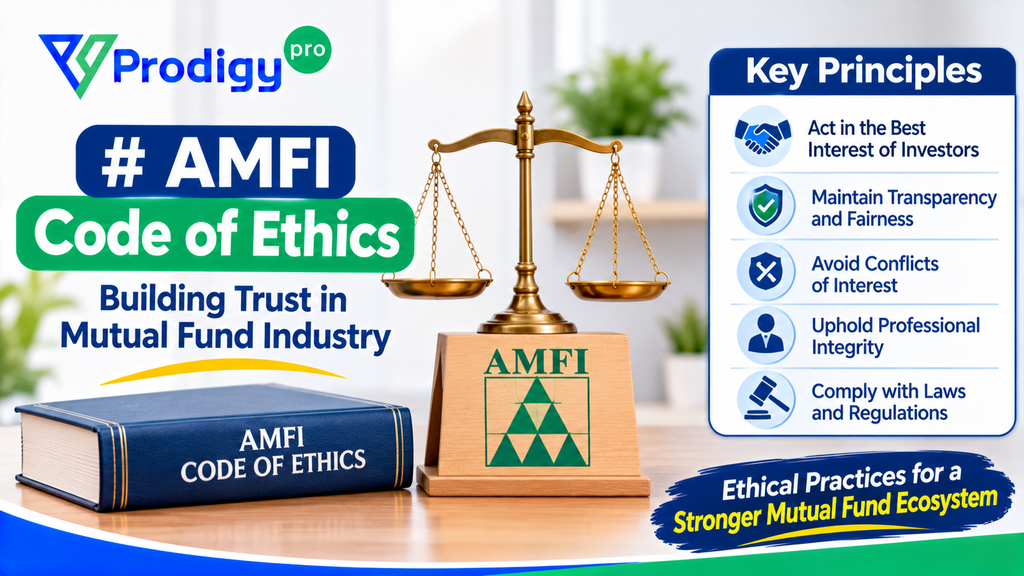
In a rapidly evolving financial market such as that of India, trust and transparency serve as the bedrock of investor confidence. When retail investors seek out mutual funds, they do so with the belief that fund managers, distributors, and intermediaries will act ethically. This trust must be upheld and fortified. To this end, the Association of Mutual Funds in India (AMFI) launched the Code of Ethics, also referred to as ACE. The Code of Ethics helps reinforce professionalism, accountability, and uniformity of practice within the industry.
In this blog, we will take a look at what the AMFI Code of Ethics is, how it is structured, how effective it is, how it is regulated and enforced, and what significance it has for investors and mutual fund professionals.
What is AMFI?
AMFI, established on August 22, 1995, is a not-for-profit industry association of SEBI-registered Asset Management Companies (AMCs). AMFI is a self-regulatory organisation that collaborates with regulators, public policy makers, and the general public.
AMFI’s goals are protecting investor interests, enhancing investor awareness, establishing uniformity of practice in mutual funds, representing and articulating the position of the mutual fund industry, and ensuring ethical practice through Codes and Guidelines.
AMFI helps Mutual Fund distributors obtain AMFI Registration Numbers (ARN) and organises investment awareness initiatives like “Mutual Funds Sahi Hai.”
Why a Code of Ethics?
While SEBI does require a minimum code of conduct under its Mutual Fund Regulations Fifth Schedule, AMFI recognised the requirement for a stronger framework. The AMFI Code of Ethics (ACE) was designed to promote higher ethical standards than the bare minimum legally required.
The purpose of the ACE is to protect the interests of investors, improve transparency, reduce conflicts of interest, and make sure that fund management is compliant, responsible, and conducted strictly in the best interests of investors.
Structure of AMFI Code of Ethics
The ACE applies to mutual fund firms, trustees, distributors, and all associated personnel. The ACE is guided by key pillars that relate to ethical investment practice:
Integrity
All parties should act honestly, with integrity, and fairly in any professional dealings. The investor’s interests must always come before those of sponsors, employees, brokers, or people acting in the capacity of intermediaries.
Due Diligence
AMCs and distributors must provide a high standard of service with professional competence and diligence. They should have processes and systems in place to ensure proper portfolio management, compliance, and risk management.
Disclosure
Full and fair disclosure of all material facts, which includes objectives of the scheme, the composition of the portfolio, risks involved, as well as expenses, is paramount. AMCs should provide sufficient, timely and easily understandable information to enable investors to make informed decisions.
Professional Selling Practices
Marketing, advertising and sales practices should be truthful, reliable and should not be misleading. Distributors and agents should be cautious about representations about past or prospective performance that might exaggerate and should avoid any practice or conduct which prioritises commission over product suitability for the investor.
Code of Conduct for Distributors (ARN Holders)
An additional ‘code of conduct’ is also applicable to mutual fund distributors who hold an AMFI Registration Number (ARN); aside from the ACE, the code of conduct to be followed has an operational purpose and explains the distributors’ obligations to investors and the industry.
Fiduciary Duty
Distributors must act in the best interest of investors; recommendations should be made only with regard to the client’s needs and not incentives for the distributor or AMC, and any potential or actual conflict of interest should be disclosed upfront.
Compliance and Competency
Distributors have to follow SEBI and AMFI regulations, including Know Your Distributor (KYD) and Know Your Client (KYC) rules. Distributors need to pass the National Institute of Securities Markets (NISM) certification and must engage in continuous professional development.
Suitability and Transparency
It is the responsibility of the distributor to determine the investor’s risk appetite and financial plan before they recommend mutual fund schemes. The distributor must provide every piece of product literature—such as fact-sheets, Key Information Memorandums (KIM), and Scheme Information Documents (SID)—and must clearly communicate the risks involved.
What is not allowed?
Distributors are not allowed to recommend mutual fund schemes by mis-selling, churning investments for the purpose of commission, splitting applications to obtain additional incentives, or offering rebates/gifts to induce investments. They are also strictly prohibited from altering documentation or issuing misleading advertisements.
Privacy and Complaint Handling
Distributors must respect the privacy of the investor’s information and must maintain a proper grievance handling mechanism to address investor complaints in a professional and timely manner.
Regulation and Oversight
While the AMFI Code of Ethics operates as an industry self-regulatory framework alongside mandatory SEBI regulations, AMFI employs an established mechanism for enforcement:
- Monitoring: AMFI undertakes the monitoring of its members’ and registered distributors’ conduct. If a member does not comply with the code or is otherwise unprofessional, AMFI will question them and will take action as it thinks appropriate.
- Complaints and Investigation: Investors and AMCs can complain to AMFI about members or registered distributors who have transgressed the code. AMFI will begin an investigation and provide an opportunity for the party to explain their conduct and, if possible, remedy it.
- Disciplinary Sanctions: AMFI can, in extreme circumstances, suspend or cancel a distributor’s ARN (AMFI Registration Number). AMFI may refer the matter to SEBI for regulatory action.
- Trustees and AMCs Obligations: AMCs have a duty (obligation) to monitor the conduct of their employees and their distributors. Trustees must ensure that if an AMC breaches the code, the breach is reported to SEBI and promptly remedied.
Advantages of the AMFI Code of Ethics
The AMFI Code of Ethics has done much to foster a culture of accountability and transparency in India’s mutual fund industry. Some of the advantages of the AMFI Code of Ethics are:
- Protecting investors: AMFI seeks to ensure that investors are offered fair and unbiased advice and that they are not misled by unscrupulous selling practices.
- Credibility: AMFI seeks to instil confidence in the mutual fund ecosystem and encourage greater retail participation.
- Specific Operational Clarity: It provides a clear set of expectations for AMCs, distributors and all other participants to follow.
- Market Discipline: It provides good guidance for market discipline as a soft regulatory mechanism.
- Harmonisation: It brings all participants into a common space of behaviour, creating commonality and professionalism in the standard of practice.
Challenges and Future Prospects
Though there are some positive trends in the way of ethical conduct through the ACE, as well as distributor codes, there are some challenges to overcome that will require additional focus:
- Deep Penetration: Virtually all of the principles of the code will need to go deeper into Tier 2 and Tier 3 towns to create some awareness amongst the distributors and clients who have not had any exposure to these principles.
- Changing Practices: The emergence of the fintech space, online platforms, and robo-advisory models requires AMFI to continuously update its ethical norms for the digital era.
- Awareness of Investor Rights: Many investors remain unaware of their rights and the available SEBI SCORES / AMFI grievance redressal mechanisms.
- Continuous Learning: Distributors and AMC staff need continuous learning to help them keep pace with the evolving regulatory and ethical landscape.
AMFI has been on top of the amendments to the Code of Conduct for Distributors; the last publication was in April 2022. As the financial landscape continues to evolve, the Code of Ethics will also continue to be a living document to evolve with new challenges and opportunities.
Conclusion
The AMFI Code of Ethics is an important cornerstone of India’s mutual fund ecosystem. By ensuring that AMCs, trustees, and distributors engage in the highest standards of integrity, professionalism, and transparency, ACE instils investor trust and promotes disciplined investing.
Due to the growing scale and complexity of the mutual fund industry, a greater emphasis on ethical conduct and investor-centric practices, characterised by dignity and respect, will become ever more important. The AMFI Code of Ethics is going to be a great part of the next wave of mutual fund growth in India, which will be grounded in trust, transparency, and value creation.
Please let me know your feedback regarding this post by leaving your comments below. You can also reach out to us via telephone, WhatsApp, or email to find out more about mutual funds, or check out our website Prodigy Pro.
Alternatively, you can download the Prodigy Pro app to start investing today.
Disclaimer – This article is for educational purposes only and does not intend to substitute expert guidance. Mutual fund investments are subject to market risks. Please read the scheme-related document carefully before investing.
FAQs
1. What is the AMFI Code of Ethics?
It is a voluntary code that was introduced by the Association of Mutual Funds in India (AMFI) to declare and adopt ethical conduct, transparency, and integrity for AMCs, distributors, and mutual fund stakeholders.
2. Which bodies have to follow the Code?
The Code is applicable to Asset Management Companies (AMCs), their trustees, employees, and registered mutual fund distributors involved in selling mutual fund products.
3. What happens if someone violates the Code?
AMFI can issue warnings, suspend or cancel a distributor’s ARN, or escalate serious violations to SEBI for regulatory enforcement. AMCs are also required to take disciplinary action against non-compliant staff or distributors.
4. In what ways does the Code protect investors?
The Code protects investors against unethical practices like mis-selling or churning, while ensuring transparency in scheme disclosures and structured grievance redressal.
5. Will the Code remain updated?
Yes. The Code of Conduct is periodically amended by AMFI to keep pace with changes in regulations, market practices & expectations from investors.