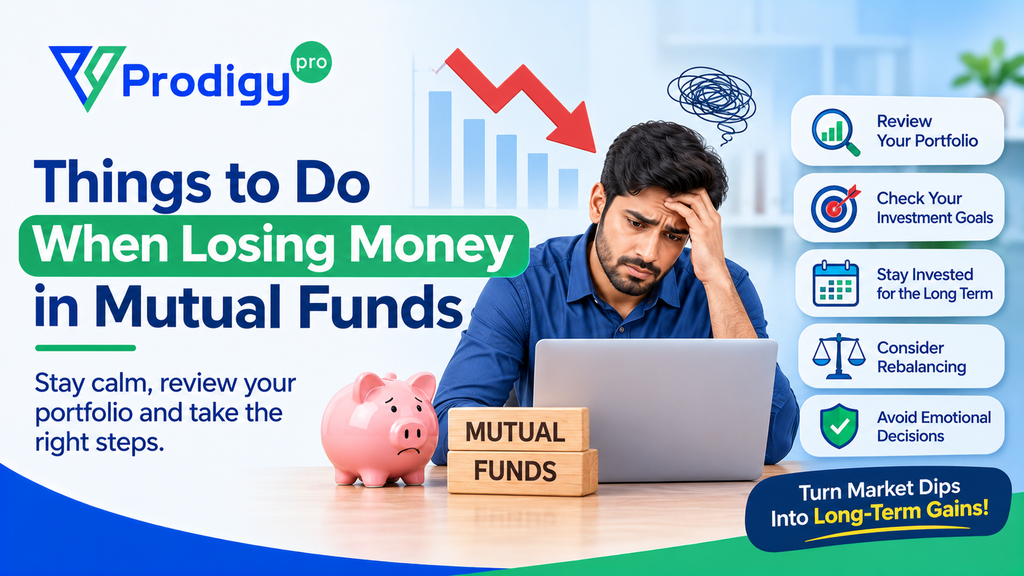
Losing Money in Mutual Funds
Investing in mutual funds helps generate long-term wealth. But a volatile market can significantly impact your returns. We understand that such a situation can make you panic and give up on your investments, but by doing that, you’ll just be inviting losses. Therefore, learning how to respond during market downturns is the best thing that one can do.
In this blog, we will elucidate step-by-step actions to take when losing money in mutual funds so you will not be distracted from your long-term financial objectives.
How Mutual Funds Lose Money
Mutual funds collect investors’ funds and invest them in a diversified basket of stocks, bonds, or other securities. The price of the underlying asset varies based on factors such as:
- Market volatility: Economic cycles, geopolitical events, changes in interest rates, and firm-specific factors result in price variations.
- Sector performance: Certain sectors will perform poorly because of shifts in demand, regulation, or disruption by technology.
- Fund management: Fund managers’ choices among assets and stocks impact returns.
- Costs: Fees and expense ratios reduce overall returns, but their impact is spread across a large portfolio of investments.
Keeping this in mind puts expectations into perspective — mutual funds will not be profitable annually. So, if you are aiming for ‘get rich in 25 days,’ then you are on the boat of disappointment.
What to Do When You’re Losing Money in Mutual Funds
1. Don’t Panic & Make Impulsive Decisions
The very first and foremost thing you have to do is remain calm. Market downturns are often temporary, but panic selling can turn temporary losses into permanent ones. Fear and uncertainty may prompt you to sell at the bottom of a market decline, causing you to miss out on the subsequent recovery.
Take some deep breaths and review your portfolio carefully.
2. Review Your Investment Horizons and Objectives
A long time horizon can save you from dealing with substantial losses. Go back to your goals:
- Do you aim to retire in 20 years, or need to fund a house deposit within 2 years?
- If you have a long-term time horizon, short-term market downturns are less of an issue.
- For short-term objectives, think of shifting to less-risky investments such as bonds or fixed deposits.
- Match your portfolio to your risk appetite and time horizon so that it aligns with your financial plan.
3. Spread Your Portfolio
Concentration risk magnifies loss. See that your portfolio is spread across:
- Various asset classes (equities, debt, gold, real estate)
- Varied sectors and industries
- A limited number of geographies (home and overseas)
- Diversification minimises risk and smooths returns over a time frame.
4. Keep Investing via Systematic Investment Plans (SIPs)
When prices fall, it’s an opportunity to buy more units at lower prices — known as rupee cost averaging. Continuing your SIP contributions during downturns can lower your average cost and increase future gains.
Stopping investments during losses might mean missing the market’s rebound.
5. Consult a Financial Advisor
If you’re unsure about your portfolio or how to proceed, consulting a certified financial advisor is a smart move. They can:
- Review your portfolio objectively
- Advise rebalancing or fund switching
- Align investments with goals and risk tolerance
- Professional advice avoids costly mistakes in volatile times.
6. Consider Rebalancing Your Portfolio
Over time, uneven returns can cause your portfolio’s asset allocation to drift away from your intended risk level. Rebalancing helps bring it back in line with your desired asset allocation by:
- Selling overweighted assets
- Buying underweighted assets
- This disciplined process keeps your investments on strategy.
7. Consider Tax Consequences Before Leaving
Redemption of mutual funds at a loss might seem sensible, but is it really? Because redemption will eventually invite:
- Capital gains tax on gains (if any).
- Capital loss benefits that may be used to offset gains elsewhere.
- Exit load charges in case of sale within a short holding period.
- Sometimes, retaining the investment for a longer term could prove to be more tax-effective.
8. Stay Informed but Don’t Over-Monitor
Keeping track of fund performance and market developments is sensible, but obsessively checking daily price movements can create unnecessary stress. Instead, schedule regular portfolio reviews every quarter or six months to assess performance and make informed, rational decisions.
Final Thoughts
When investing in mutual funds, you should act smart. By checking your goals, diversifying, being regular with SIPs, taking professional advice, and rebalancing whenever necessary, you can mitigate risk and deal with market volatility successfully.
Please share your thoughts on this post by leaving a reply in the comments section. Contact us via Phone, WhatsApp, or Email to learn more about mutual funds, or visit our website https://bfccapital.com/ .
Alternatively, you can download the Prodigy Pro app to start investing today!
Disclaimer – This article is for educational purposes only and does not intend to substitute expert guidance. Mutual fund investments are subject to market risks. Please read the scheme-related document carefully before investing.
Frequently Asked Questions (FAQs)
1. Do I sell my mutual funds when they report losses?
No. Bottom-fishing can trap losses. Match your investment horizon, goals, and fund performance before acting.
2. How long do you keep mutual funds in a falling market?
Ideally, you should keep mutual funds for 3-5 years or even longer to weather volatility and capture the rallies in the recovery.
3. Can you make SIP investments continue even during a losing phase?
Yes. Sticking to SIPs means buying more units when markets are down, lowering your cost, and perhaps boosting returns.
4. How frequently should you rebalance and review your portfolio?
Generally, update your portfolio every 6-12 months to make sure it is still in accordance with your risk tolerance and objectives.
5. When do I need to talk with a financial advisor regarding my mutual fund investments?
If you are not sure how your portfolio is doing and what you have invested in, talking with a financial advisor will give you personalised advice.