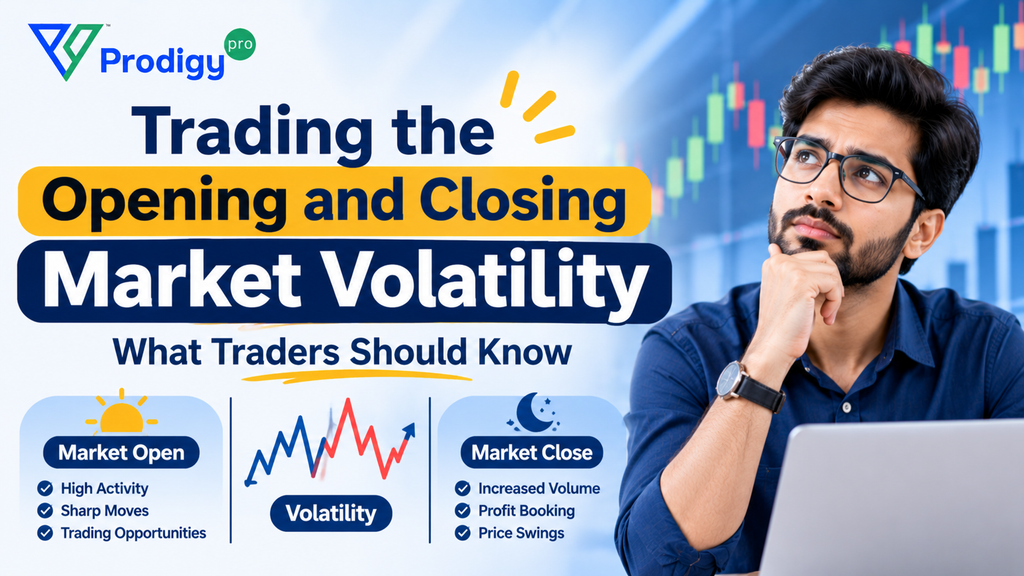
The stock market is a volatile and sometimes unpredictable place. Of its numerous characteristics, volatility is perhaps the most ubiquitous and dominant force. To investors and traders, an awareness of volatility, especially when found at the opening and closing of the market, can be the key difference between profit and loss.
This blog will explore the topic of what market volatility is, i.e., in the share market context, and also to what extent the sharp variations in price at the start and end of trading sessions are being tapped by traders.
What Is Volatility?
Volatility is simply the degree of change in the price of a financial instrument within a time frame. In the stock market, it is a measure of how much the price of a share varies up and down during a given period.
A share that experiences rapid and large price movements within a limited time frame is highly volatile. A share exhibiting relatively stable and minor changes is low volatility.
Volatility is generally measured by:
- Standard deviation: Measures the dispersion of a list of prices from the average.
- Beta coefficient: Measures the volatility of an individual share compared to the market as a whole.
- Implied volatility (IV): Applied to options markets, describing expected future volatility.
Volatile Meaning in the Share Market
Share market volatility is more than a technical label; it’s a measurement of investor attitude, economic climate, and extraneous factors like geopolitical happenings or movements in interest rates.
A volatile share market can:
- Open with a gap higher or lower.
- React quickly to news or data releases.
- See sudden action at the bell close as investors sell their stock.
Volatility is caused by:
- Earnings releases
- Government policy changes
- World economic events
- Uncertainty in interest rates
- Unexpected events (e.g., pandemics, wars)
This is the kind of volatility that intimidates the market to new traders. But for professional traders, volatility is also an opportunity—especially during the opening and closing of the trading period.
Stock Market Volatility: Why the Opening and Closing Matter
Let us examine how volatility actually occurs at the moment of market opening and closing.
The Opening Bell: Riot or Opportunity?
The initial half hour of the market opening (typically 9:15 AM to 9:45 AM in the Indian market or 9:30 AM to 10:00 AM in the US) is typically marked by higher volatility. This is caused by:
- Local and international news from the late night is digested.
- Orders and pre-open trades pile up prior to the actual opening.
- Institutional investors re-position themselves on the basis of global clues.
This leads to gap-ups or gap-downs—i.e., the stock opening considerably higher or lower than it closed the day before—impacting price movements quite often. These are useful for day traders who make hay while the sun shines, i.e., hold on through short-term price variability.
Closing Hour: Race Against Time
Likewise, the closing hour of trading—particularly the last 30 minutes—is replete with rapid movements. This is due to:
- Traders closing intraday trades.
- Portfolio managers rebalancing.
- Speculators making last-minute wagers.
- High-frequency traders reacting to end-of-day news.
This hour is crucial because:
- It frequently dictates the day’s ultimate direction of price.
- It sends signals for the direction of opening on the next day.
In this way, traders who can navigate closing-hour volatility can both profit on a short-term basis and gain on the next day.
How Traders Profit from Volatility
Volatility isn’t bad. To a trader, it is actually a requirement. Without volatility in prices, there isn’t any means to make a profit. This is how traders earn:
Scalping and Intraday Strategies
Scalpers and intraday traders benefit from high volatility. The quick movement of the market opening and closing gives them multiple entry and exit opportunities. But this room requires:
- Stringent risk management
- Self-discipline and self-control
- Quick decision-making
Volatility Breakout Trading
It is a matter of finding price consolidation, followed by an unexpected breakout, typically occurring on opening and closing. Technical tools like Bollinger Bands or Volume analysis are used by traders to spot these breakouts.
Options Trading
Increased volatility brings higher premiums for options, which are beneficial for the sellers. Buyers of options can use increasing volatility for quick gains in case the direction is right.
Tools to Trade Volatility Successfully
In order to successfully trade market volatility—opening and closing hours in particular—there exist some instruments and techniques that must be utilised by traders:
- Volatility Indicators
- Average True Range (ATR): It measures how far a stock generally moves during the day.
- VIX (Volatility Index): Also called the “fear index,” it is a gauge of expected market volatility.
- Candlestick Patterns
- Doji, Engulfing, and Morning Star patterns usually form on very volatile trading days and are tradeable signals.
- Volume Analysis
- Heavy trading on volatile moves confirms the validity of the move, which leaves the trader with more confidence.
Hazards of Trading Volatility
Volatility by way of opportunity is riskier. Management of an entry or an exit goes wrong, leading to quick losses. Common risks are:
- Slippage: Orders filled at rates that were not anticipated.
- Whipsaws: Quick reversals that catch the trader in the middle.
- Emotional trading: Greed and fear prevail over sense.
Thus, risk management is very crucial. Always use stop-loss orders, never over-leverage, and trade according to your plan.
New Trader Tips
- Avoid the initial 15 minutes if you are a new trader—it is choppy.
- Use simulation mode initially before trading actual money during volatile hours.
- Invest in lower-priced shares or indices which you are familiar with.
- Always use a stop-loss.
- Get familiar with historical volatility patterns in certain stocks or sectors.
Conclusion
Market volatility is a double-edged sword for traders – specifically because it not only verifies additional profit opportunities, but also provides more risk opportunities. Trading volatility requires structured risk management and discipline rather than pure instinct, having the right tools, and showing discipline in the appropriate context to take advantage of it.
Whether you are a day trader focused on small timeframes, or a longer-term swing trader, learning how the market trades in volatility is an important skill for all traders. After all, you cannot run from the storm; learning how to dance in the rain is far more advantageous.
Let us know your thoughts in the comments section below. If you are interested in mutual funds, please contact us by Phone, WhatsApp, or Email, or feel free to access our website Prodigy Pro. You can also download the Prodigy Pro app and begin investing today!
FAQs
1. What does volatility mean in the context of the stock market?
Volatility refers to the degree of price movement or fluctuation in a stock or the overall market over a specific period. Higher volatility means larger and more frequent price swings.
2. Why is the market often more volatile during opening and closing hours?
At market open, traders react to overnight news, global cues, and pre-market orders. At market close, they adjust or close positions, leading to sharp price movements. These periods involve high trading volume and uncertainty, increasing volatility.
3. What are two common tools used to measure market volatility?
- Average True Range (ATR) – shows the average price movement of a stock over time.
- VIX (Volatility Index) – measures expected future volatility in the market.
4. How can traders benefit from volatility during market open and close?
Traders can take advantage of quick price swings to enter and exit trades for short-term profits, using strategies like scalping, breakout trading, or options trading during these high-volatility periods.
5. What are some risks involved in trading highly volatile markets?
Risks include price slippage, false signals (whipsaws), emotional decision-making, and rapid losses if trades go against expectations. Proper risk management is essential.