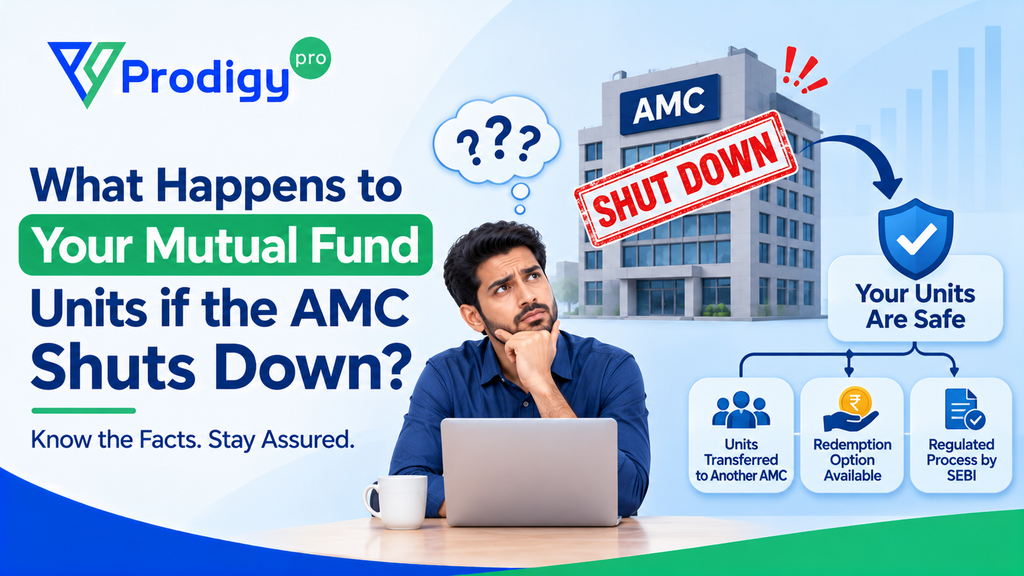
What if the company managing your mutual fund suddenly AMC shuts down? Does your investment disappear with it? Fortunately, the answer is no. The money you’ve invested in a mutual fund is held separately from the AMC’s finances. So even if the company managing the fund goes out of business, your investment remains safe.
Usually, the money is switched to another AMC, and as an investor, you will be able to stay with the new manager or withdraw your money. During this transition, the value of your investment, known as the Net Asset Value (NAV), is not affected by the closure of the AMC. You still own the same number of units, and their value still reflects the market performance of the fund holdings.
What Happens If an AMC Shuts Down?
The following is a detailed list of the most important effects an AMC shutdown can have:
How is Fund Management Transferred?
If the AMC shuts down:
- The trustee approaches a new AMC to take over the management of the funds.
- In the meantime, fund operations can be suspended or restricted temporarily.
- The transfer process is controlled by financial regulators to ensure transparency.
Option to Exit
Once a new AMC is allotted:
- Investors are informed about the changes.
- You can choose to stay invested or switch out at no charge (in most cases).
What Happens When a Mutual Fund Company Closes
An Asset Management Company may shut down for several reasons—failure of business, mergers, regulatory issues, or voluntary closure. But your money is not directly at risk, as mutual fund assets are held separately from the AMC’s own money.
Investor safety in mutual funds is a major focus for regulators and fund houses. While mutual funds carry market risks, several safeguards protect investors from mismanagement, fraud, or losses due to reasons unrelated to market performance.
If an Asset Management Company (AMC) shuts down or winds up business in India, the Securities and Exchange Board of India (SEBI) has clear directions to protect investors’ interests.
Fund Asset Transfer in Mutual Funds
A transfer of assets of a fund occurs when the management of an AMC or its assets is transferred from one AMC to another. This could be due to various reasons such as mergers, acquisitions, restructuring, or closure of an AMC.
Mutual fund liquidation
It is when a mutual fundhttps://prodigypro.co.in/mutual-funds is closed down forever, and the assets are wound up. The proceeds are divided among the investors based on the then prevailing Net Asset Value (NAV) of the fund. This can be voluntarily done by the fund house or forced by regulators in exceptional cases.
Reversal of AMCs
When a mutual fund changes AMCs (the fund manager), it can seem ominous, but it’s a formal, regulated process that typically preserves continuity and investor safety.
A Mutual Fund Merger
A mutual fund merger takes place when two or more schemes (or funds) are merged into a single one. It can be within the same AMC or between different AMCs, and is normally for greater efficiency, less redundancy, or meeting regulatory necessities.
How are Mutual Fund Investments Protected
Investor protection is one of the fundamental principles of mutual fund regulation. Regulatory bodies such as SEBI in India, the SEC in the USA, and the FCA in the UK have established safeguards to promote transparency, ensure accountability, and protect investors’ interests against operational risks, fraud, and other potential threats.
NAV (Net Asset Value) is the unit price of a mutual fund scheme—It represents the per-unit value of a mutual fund scheme, calculated by dividing its net assets (total assets minus liabilities) by the number of outstanding units. NAV continuity refers to the consistent daily calculation and disclosure of this value, ensuring transparency and maintaining investor confidence.
In India, if an Asset Management Company (AMC) decides to exit the mutual fund business—voluntary winding up, amalgamation, or transferring its schemes to another AMC—there are regulations in place provided by SEBI (Securities and Exchange Board of India) to protect investors and ensure continuity.
AMFI’s Role in AMC Closure
The Association of Mutual Funds in India (AMFI) plays a supportive and regulatory liaison role when an Asset Management Company (AMC) exits the mutual fund business. While AMFI does not directly regulate mutual funds (that’s SEBI’s role), it helps maintain industry stability, transparency, and investor communication.
Investor Redemptions During AMC Exit or Shutdown
When an Asset Management Company (AMC) exits or shuts down its mutual fund operations, investors often consider redeeming their investments due to uncertainty. However, the process is governed and protected by SEBI regulations, ensuring investors can safely exit or remain invested.
On a Parting Note
An AMC shutting down may sound alarming, but it does not automatically put your mutual fund investments at risk. Since scheme assets are held separately from the AMC’s own finances, investors remain protected from the AMC’s business liabilities. In India, SEBI-regulated procedures ensure that schemes can be transferred to another AMC or wound up in an orderly manner, keeping investor interests in focus. However, this does not eliminate market risks or guarantee returns. As an investor, stay informed about official communications, understand your options, and make decisions based on your financial goals rather than panic.
Please share your thoughts on this post by leaving a reply in the comments section. Contact us via Phone, WhatsApp, or Email to learn more about mutual funds, or visit our website https://bfccapital.com/ .
Alternatively, you can download the Prodigy Pro app to start investing today!
Disclaimer – This article is for educational purposes only and does not intend to substitute expert guidance. Mutual fund investments are subject to market risks. Please read the scheme-related document carefully before investing.
FAQs
1. Will I lose my money if the AMC shuts down?
No. Your money is invested in underlying assets like stocks and bonds, held separately by a custodian. The AMC does not own these assets.
2. What does SEBI or the regulator do in this case?
SEBI ensures that investor interests are safeguarded. It supervises the process of winding down or transferring schemes to another AMC.
3. Can I redeem my mutual fund units during this process?
Yes. Investors are usually allowed to redeem their units without an exit load during the transition.