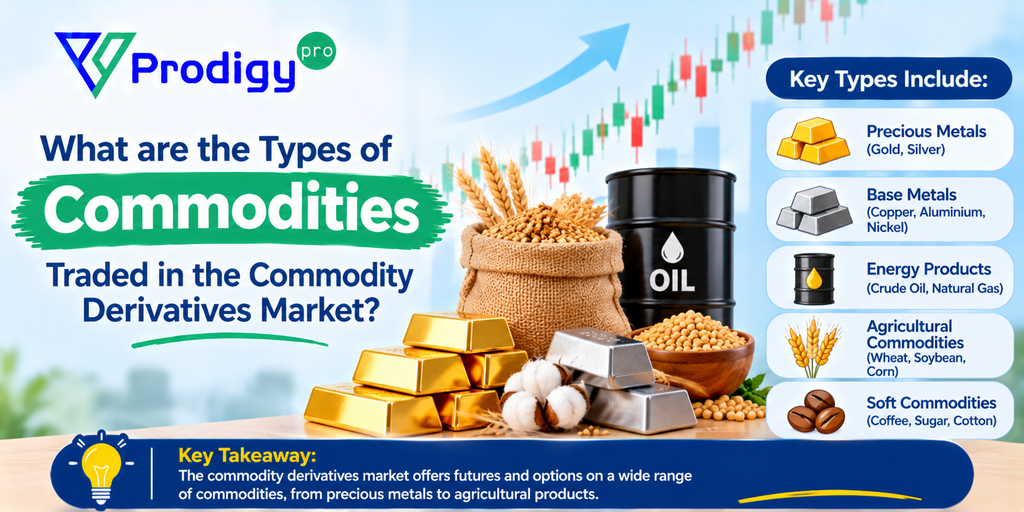
The commodity derivatives market helps investors safeguard against risks and speculate on price movements. Commodity derivatives are considered financial instruments whose value is derived from primary physical commodities. These commitments help market participants manage price volatility and increase market liquidity. Knowing about the types of commodities that are traded in the derivatives market is important for effective trading and market analysis.
A Look Into the Commodity Derivatives Market
The commodity derivatives market, or a commodity derivative segment of a recognised stock exchange, is the electronic platform of a recognised stock exchange wherein commodity derivatives are transacted. It provides the facility for transactions in different commodities, mainly through contracts such as futures, options, and swaps. These instruments provide investors the ability to buy or sell commodities at prearranged prices, which even minimises the exposure to price fluctuations.
Commodity derivatives were initially traded on different exchanges that specialise in trading in Commodity Derivatives exclusively, such as MCX and NCDEX. After October 01, 2018, a single exchange has been permitted to operate various segments such as equity, equity derivatives, commodity derivatives, currency derivatives, interest rate futures & debt, etc. For example, post-integration, NSE and BSE launched a specialised segment for commodity derivatives trading.
Who Regulates the Commodity Market?
The commodity derivatives market in India is regulated by the Securities and Exchange Board of India (SEBI) since September 28, 2015. Before September 28, 2015, the Commodity derivatives market was regulated by the erstwhile Forward Markets Commission (FMC).
Types of Commodities Traded in India
In India, the commodity market is well-defined under two major categories:
Physical Commodity Market: This is a physical, hand-to-hand market. The traders mainly meet in the central market to buy and sell the commodities. The commodities which are traded in this market consist of grains, cereals and pulses, various metals like gold and silver, industrial products like textiles and fertilisers, and also petroleum products.
Financial Commodity Market: This market is based on contracts and paper trading, in place of the physical exchange of goods. This market includes the futures market for natural resources like agricultural, metal, energy and weather.
1. Agricultural Commodities
Agricultural commodities form a notable part of the commodity derivatives market. These take into consideration the staple food products and raw materials that come under the use of various industries. Some commonly traded agricultural commodities are:
- Grains and Cereals: Wheat (Traded on NCDEX), corn, rice, and barley play an essential role in food production, as they are traded widely.
- Oilseeds and Edible oil: It includes soybean, mustard seeds and crude palm oil
- Spices and Plantation: It includes pepper, which is traded on the MCX, along with cardamom and rubber, which are also traded in the market.
- Soft Commodities: Cotton and Sugar are considered soft commodities, and they are of high value and are always in global demand.
In order to forecast price fluctuations, market research of agricultural commodities sometimes entails examining variables including production data, weather trends, and geopolitical events.
2. Metal Commodities
Metal commodities are categorised into precious and industrial metals; they depend on market needs:
- Precious Metals: Gold, silver, platinum, and palladium are valued for their use in jewellery, investment, and industrial applications. Gold derivatives are popular because they act as a protection against rising prices and economic uncertainty.
- Industrial Metals: Copper, aluminium, zinc, lead, and nickel are used for construction, manufacturing, and technology industries.
Trends in industrial demand, economic growth indices, and mining output are all taken into account in the market analysis of metal commodities.
3. Energy Commodities
Energy commodities are among the most liquid and widely traded in the derivatives market as they play an important role in industrial production and transportation. The major energy commodities include:
- Crude Oil and Petroleum Products: Crude oil acts as one of the major primary sources for industries, transportation and households. It is considered one of the important traded commodities in India. Therefore, its rates affect the global economy.
- Natural Gas: Majorly used in electricity generation and heating, natural gas futures and options are popular trading instruments. It even acts as a cleaner energy solution and suffices the country’s growing energy needs.
- Coal: Although the demand for coal often fluctuates due to major environmental concerns, coal derivatives remain important in some markets.
Energy commodity trading is deliberately influenced by geopolitical tensions, government policies, and technological advancements in renewable energy.
How Commodity Derivatives Trading Works?
Commodity derivatives trading is managed on different exchanges, which include Multi Commodity Exchange (MCX), Indian Commodity Exchange (ICEX), National Commodity and Derivatives Exchange (NCDEX) and National Multi Commodity Exchange (NMCE). Traders often participate in the market under different types of contracts:
- Futures Contracts: Systematised agreements to buy or sell a commodity or asset at a future date and a pre-planned rate. If such a trade is monitored by a commodity exchange, it is then called a futures contract.
- Options Contracts: Provide the right to buy or sell an asset or commodity at a specific price before it expires. As per 2017 SEBI regulations, investors have a choice and not a compulsion to buy or sell a commodity derivative at a set price.
When trading commodity derivatives, market analysis includes assessing supply and demand patterns, economic indicators, geopolitical happenings, and technical chart patterns.
The Importance of the Commodity Derivatives Market
The commodity derivatives market plays a major role in global finance by:
- Providing Risk Management: It enables the producers, consumers, and investors to safeguard against volatility. Producers can also hedge against adverse movements in price by locking in future prices for protection.
- Enhancing Liquidity: It encourages market participation, which leads to improved price discovery and mechanisms.
- Promoting Economic Stability: It leads to less uncertainty in commodity pricing and even supports business planning and investment decisions.
- Encouraging Investment Opportunities: It allows traders to venture into price movements and even broaden and expand their investments.
Conclusion
Commodity derivatives trading provides an organised framework for reducing and mitigating risks, price determination, and investment opportunities. With different commodities available in the market, traders and investors can outline a framework and strategies depending on the comprehensive market analysis to enhance their trading decisions. Whether investing in agricultural, energy, metal, or environmental commodities, knowing the market dynamics is important for success and growth in the commodity derivatives market.
Please share your thoughts on this post by leaving a reply in the comments section. Contact us via Phone, WhatsApp, or Email to learn more about mutual funds, or visit our website (https://bfccapital.com/).
Alternatively, you can download the Prodigy Pro app to start investing today!
Disclaimer – This article is for educational purposes only and does not intend to substitute expert guidance. Mutual fund investments are subject to market risks. Please read the scheme-related document carefully before investing.
FAQs
1. What are the most commonly traded commodities in the derivatives market?
The most commonly traded commodities are crude oil, natural gas, gold, silver, wheat, corn, and copper. These goods are highly liquid and in great demand worldwide.
2. How do commodity derivatives help in risk management?
Commodity derivatives allow businesses and investors to hedge and reduce risk and buffer fluctuations by locking in future prices through futures, options, and swap contracts.
3. What factors influence commodity prices in the derivatives market?
Commodity prices are affected by factors such as supply and demand variability, geopolitical events, weather conditions, economic indicators, and even risky investments.
4. What are the main exchanges for commodity derivatives trading?
Major exchanges are the Multi Commodity Exchange (MCX), Indian Commodity Exchange (ICEX), National Commodity and Derivatives Exchange (NCDEX) and National Multi Commodity Exchange (NMCE).
5. How can beginners start trading in commodity derivatives?
For beginners, it is very important to know and understand the market fundamentals first, studying price trends, making use of demo accounts, and taking guidance from financial experts before you jump into the actual trading process.