Bid Price and Ask Price
Have you ever glanced at a stock quote and wondered what those mysterious numbers labeled “bid” and “ask” really mean? While the terms may sound a bit like financial jargon, they’re actually at the heart of every trade you make—whether you’re buying a share of your favourite company or exchanging currency for your next trip. Understanding the bid price and ask price isn’t just for trading pros; it’s a key to knowing exactly what you’ll pay when you buy or what you’ll get when you sell. And these concepts don’t just apply to stocks—they’re fundamental to markets of all kinds.
Here in this blog, we will be understanding both prices with clarity. Moreover, we will look into the difference between bid price and ask price, why they matter, and what factors affect the differences. So without any further ado, let’s quickly jump into the topic.
What Is A Bid Price?
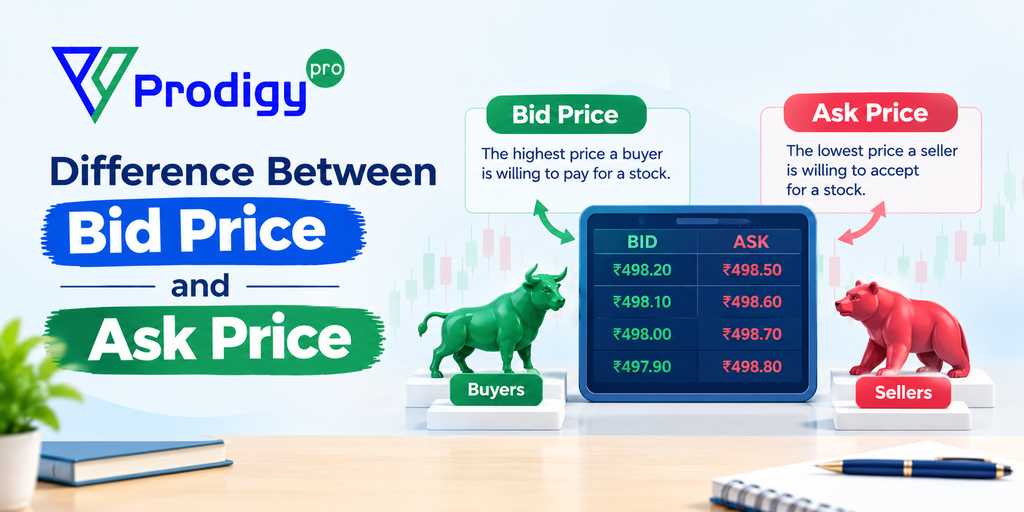
Let’s start with the bid price first. In the easiest way, bid price generally refers to the highest amount someone is ready to pay for a particular asset. For instance, assume you are selling a smartphone for 10,000 rupees, but a potential buyer is offering you 8,000 rupees. That 8,000 rupees is the bid price. It’s all about how much a person is ready to spend to buy the phone from you.
In the share market, it works in the same way. For example, the bid price of ABC stock is 10 rupees, and someone out there is ready to pay that amount to buy the share. In the financial market, if you are willing to sell shares of a particular company, the bid price will always prefer the maximum amount buyers are ready to pay.
Another thing investors should remember is that if you sell your asset immediately at the market price, you are going to receive the current bid price.
What Is An Ask Price?
Simply put: the ask price refers to the lowest amount a seller is accepting for an asset. Let’s use that smartphone example again. Imagine you’ve found a seller listing a smartphone for Rs 11,000. That’s the ask price: the amount the seller wants in exchange for the phone.
The share market works the same way. If the ask price for ABC Company is Rs 20, it means someone is ready to sell you that stock at Rs 20.
Remember, when you want to buy shares immediately at the market price, you are paying the ask price. The ask price is typically higher than the bid price, and it reflects what sellers are willing to accept at that moment.
Explanation of Bid-Ask Spread
The difference between the bid price and ask price is commonly known as the bid-ask spread. It basically refers to the price gap between what a buyer wants to pay and what a seller wants to receive.
Let’s take a look at our smartphone example again. As we mentioned, the bid price was 10,000 rupees and the ask price was 11,000 rupees. A 1,000 rupee gap is becoming visible, and that is known as the bid-ask spread.
This spread shows a hidden cost for the traders. You immediately lose the bid-ask spread if you purchase at the ask price and sell at the bid price with no change in price. This is an implicit expense that is particularly significant for traders who conduct a lot of transactions.
For example, if the ask price is 31 rupees for a share and you are selling it at Rs 30, which is the bid price, then you are losing a total of 1 rupee per share.
Why Must You Care About The Bid & Ask Prices?
Whether you are a trader or an investor, understanding the importance of bid price and ask prices is crucial. It directly impacts the success of your trading journey. Here are a few reasons why you must pay attention to the number of bids and asks.
- Execution price matters a lot if you want to gain profit. When you buy, you pay the ask price, but when you sell, you receive the bid price.
- To reduce hidden fees, focus on assets with tight spreads. For active traders, even a small bid-ask spread can add up to a significant amount over time.
- Knowing the bid-ask spread helps you judge how liquid a stock is and what it will really cost to trade it.
Wrapping Up
In the share market, you can’t gain profit for a long time if you don’t have a deep idea about the technicalities. The bid price and ask price are equally important for every investor and trader who is consistent and wants to make informed decisions. So next time, don’t just look at the prices; rather, compare the tiny gap because it can make a big difference in the long run.
Please share your thoughts on this post by leaving a reply in the comments section. Contact us via Phone, WhatsApp, or Email to learn more about mutual funds, or visit our website. Alternatively, you can download the Prodigy Pro app to start investing today!
Disclaimer – This article is for educational purposes only and does not intend to substitute expert guidance. Mutual fund investments are subject to market risks. Please read the scheme-related document carefully before investing.
FAQs
- Why is the bid price always lower than the ask price?
It is a natural gap between a buyer and a seller. A buyer always wants to pay the lowest price, whereas a seller always prefers the highest price.
- How does market volatility affect the bid and ask prices?
High volatility means market uncertainty; therefore, it leads to wide gaps between the bid and ask prices. In highly liquid stocks or assets, the spread may remain narrow despite volatility due to high trading volume.
- What is a limit order, and how is it related to the bid & ask price?
A limit order lets you set the exact price at which you want to buy (or sell) a share. It is executed only when the market reaches that price.
- How does the electronic trading platform affect the bid-ask price?
By connecting more buyers and sellers, electronic platforms often lead to a tighter spread and faster execution.
- How can I track the bid and ask price while trading?
Many brokerage platforms, trading apps, and financial news websites let you track live prices. You can use them to time your trades accordingly.