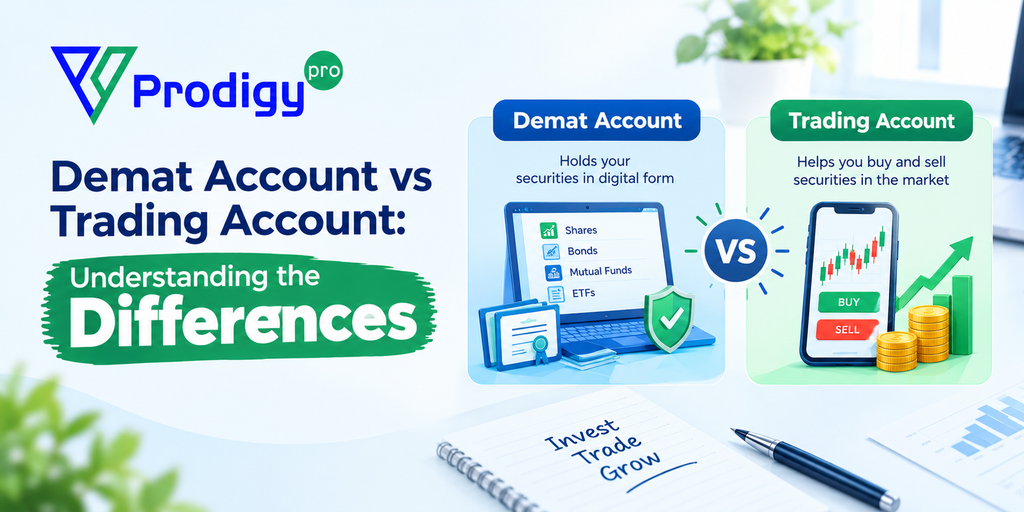
Understanding financial tools is crucial when investing in the stock market, including both demat and trading accounts. Several investors, mostly beginners, often get confused between these two accounts. Although both accounts are important for investments, they serve distinct purposes.
This article will explore the key differences between a Demat account vs Trading Account, their functions and benefits.
What is a Demat Account?
A Demat Account (Dematerialised Account) is basically used to hold securities in digitised form. Initially, investors used to get their share certificates in hard copy when they bought stocks. But Demat accounts made the process paperless, making trading safer and easier for investors.
Demat Account: Features
There are several features of the demat account, which are listed below:
- Electronic Storage: It stores shares and other financial assets in a digital form.
- Security: The demat account mainly protects against risks like loss, theft, or damage to physical share certificates.
- Ease of Transfer: It facilitates seamless and easy transfer of securities and digital assets.
- Access to Multiple Investments: In addition to stocks, a Demat account can also hold bonds, mutual funds, ETFs, and government securities.
What is a Trading Account?
A Trading Account functions as a bridge between the investor and the stock exchange. It is mainly used to buy and sell securities in the stock market. If an investor wants to trade, they use a trading account for placing orders, which are carried out on the stock exchange.
Also Read– https://prodigypro.co.in/blog/upper-circuit-and-lower-circuit
Trading Account: Features
There are several features of the trading account, which are listed below:
- Facilitates Transactions: It provides the facility to buy and sell shares and securities.
- Linked to a Bank & Demat Account: Funds are debited or credited from the linked bank account, and securities are credited or debited from the Demat account.
- Real-Time Market Access: It provides investors with the facility to track their stock prices and buy or sell stocks.
- Reinforces Different Investment Instruments: Apart from stocks, a trading account even enables investments in assets, futures contracts, and options.
What Are The Major Differences Between A Demat Account Vs Trading Account?
| Feature | Demat Account | Trading Account |
| Purpose | The securities are kept in digital form. | Helps in the buying and selling of assets and securities. |
| Function | It can act as a digital locker. | This acts as a platform to buy and sell stocks. |
| Link to the Stock Market | It has no direct link with the stock market; it just works for their storage. | It is directly connected with the stock exchange. |
| Transactions | It only works for credit or debit cards | Trade execution is facilitated through it. |
| Account Type | It is a Depository Account | It is a Transactional Account |
How Do Demat and Trading Accounts Work Together?
When you are thinking of investing in the stock market, you must know that both the Demat and Trading accounts work hand in hand:
- Buying Stocks: A trading account is used to buy and sell shares from the stock market, and they are transferred and stored in the Demat account.
- Selling Stocks: A trading account is used to sell the shares. The Trading Account places a sell order, and the equivalent shares are debited from your Demat Account.
- Bank Account Linkage: Both these demat and trading accounts are linked to your bank account, making securities transactions easy.
What are the Benefits of Having a Demat and Trading Account?
Advantages of a Demat Account:
- Safe & Secure: There is no risk of losing physical share certificates.
- Convenient: Provides an easy transfer of securities and assets.
- Access to Multiple Investments: It holds bonds, ETFs, and more apart from stocks.
- No Paperwork: It provides ease in the investment work and is all paperless.
Advantages of a Trading Account:
- Real-Time Transactions: It provides instant buying and selling of securities.
- Access to Various Markets: Facilitates trading in stocks, derivatives, and commodities.
- Seamless Banking Integration: Connects with a bank and Demat account for smooth transactions.
- Market Insights & Reports: Many trading platforms provide market research, analytics, and trading insights.
How to Open a Demat and Trading Account?
The steps for opening a Demat and trading account are given below:
- Select a Depository Participant (DP) like a bank, registered stockbroker, or financial company.
- Submit KYC documents including PAN card, Aadhaar card, and proof of address.
- Fill out the application form and complete the verification process.
- Once the application and verification are approved, you will receive Demat Account and Trading Account details to start holding securities digitally.
- Link your bank account and trading account for simple and seamless transactions.
- Once the account is activated, you receive login credentials to trade in the stock market.
How to choose the right broker for your investments?
When the investor selects the broker for opening their Demat and Trading Account, they should keep the following points in mind:
- Brokerage Fees & Charges – Always compare the transaction costs.
- User-Friendly Platform – The trading interface is quick and user-friendly.
- Customer Support – Make sure that troubleshooting is available 24*7.
- Research & Analysis Tools – Always choose a broker that provides market insights and guides you properly.
- Security & Compliance – Always select SEBI-registered brokers, as it ensures your safety.
Conclusion
A Demat Account and a Trading Account are both important for stock market investments, but they carry out different functions and benefits. While the Demat Account stores your securities digitally, the Trading Account helps you buy and sell shares. Understanding their roles and functions will help you steer the stock market efficiently and make well-researched financial decisions. For a seamless trading experience, ensure you open both accounts with a reputable financial institution.
Please share your thoughts on this post by leaving a reply in the comments section. Contact us via phone, WhatsApp, or email to learn more about mutual funds, or visit our website. Alternatively, you can download the Prodigy Pro app to start investing today!
Disclaimer: This article is for educational purposes only and does not intend to substitute expert guidance. Mutual fund investments are subject to market risks. Please read the scheme-related document carefully before investing.
Frequently Asked Questions (FAQs)
1. Can I trade in the stock market with only a Demat Account?
No, a Demat Account stores your securities in a digitised form; the Trading Account helps in the buying and selling of shares.
2. Do I need separate Demat and Trading accounts for different stock exchanges?
No, a single Demat Account and Trading Account can help you trade across multiple exchanges like NSE and BSE.
3. What are the charges associated with Demat and Trading accounts?
While opening a trading and demat account, charges like account opening fees, annual maintenance charges (AMC), brokerage fees, and transaction costs are charged. They may vary and depend on your selected broker.
4. Can I have multiple Demat and Trading accounts?
Yes, an investor can possess more than one Demat and Trading Account with different brokers, but it depends on the investor to manage them effectively.
5. How long does it take to open a Demat and Trading Account?
While traditional methods may take one to three days, several brokers provide quick account activation with online KYC verification.