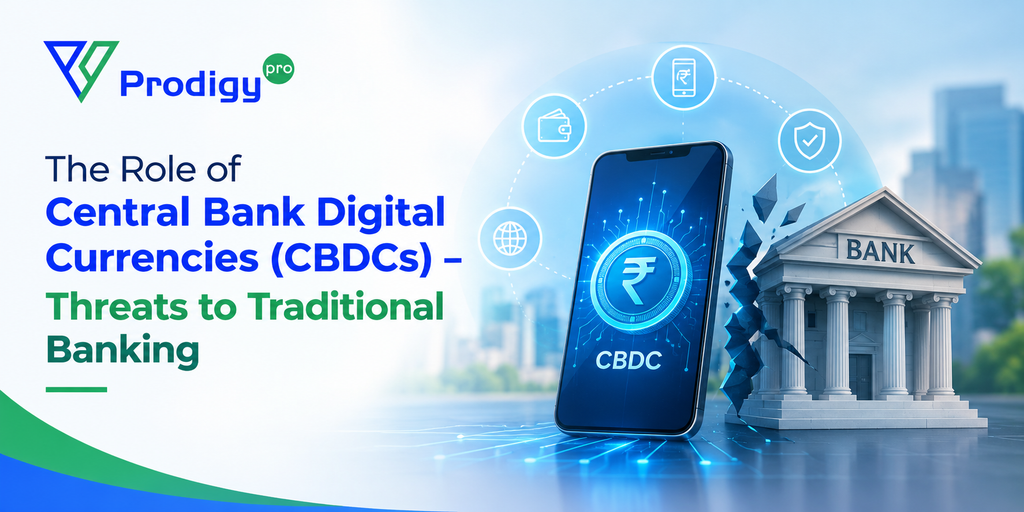
The way we use money is changing. From cash payments to UPI transfers, digital technology has transformed how people send, receive, and manage money. The next development in this evolution is the Central Bank Digital Currency (CBDC).
What is a Central Bank Digital Currency?
A CBDC is a digital form of a country’s official currency issued by its central bank. In India, the Reserve Bank of India (RBI) issues it as the Digital Rupee.
Central banks issue CBDCs, which represent a direct liability of that institution. They are designed to complement existing forms of money and can offer benefits such as efficient payments, faster settlement, and improved financial inclusion.
However, CBDCs could also change how traditional banks operate. If customers begin shifting a significant portion of their bank deposits into digital currencies, banks may face challenges related to lending, liquidity, profitability, and financial stability.
Key Ways CBDCs Could Impact Traditional Banking
Let’s understand the key threats CBDCs could pose to traditional banking and why their design and implementation matter.
- Privacy Aspects
There are two major concerns about CBDCs, and they are as follows;
- When it comes to digital currency, there is always an increase in concern about privacy and security. When a person is using a CBDC, it is always traceable by the central bank or central government. This is the only privacy concern people have, and it makes them feel that traditional banking is more trustworthy.
- Aside from surveillance, a disruption can be identified in the regulatory framework of banks. The system starts adapting more to the environment of the bank in the everyday operations of the money supply.
- Less Customer Interaction
The more people become dependent on digital processes for banking, the less people will visit banks. Due to these changes, customer interaction automatically decreases. By following the traditional strategy, banks used to engage more customers, but nowadays, the implementation of CBDC is changing the entire banking scenario.
- Security Concern
When it comes to digital money, security is a major concern. Here are the points,
- A destabilisation of the banking system can be seen if any crisis or economic uncertainty occurs. Generally, in such situations, people will prefer to shift their funds from regular or commercial banks to get safety assurance.
- Compared to the traditional banking system, digital currencies are much less safe. CBDC, or central bank digital currency, will always have cybersecurity concerns. Due to this, financial instability is a concern with CBDCs.
- Impacts On Lending Capacity Of Banks
Lending money is a major part of every bank. If you look at the traditional banking process, you will see that it depends on customers to deposit money. But if the customer starts depositing in CBDC, the banks will start to face a major downfall. This is the most common and obvious reason why traditional banks can start losing their lending capacity due to the increasing acceptance of central bank digital currency. According to the experts, two separate functions, like store of value and bank credit functions, can mitigate the risk factors.
- Payment Facts
With CBDC, customers will get 2 payment options. One is an instant payment, and the other is a cross-border transaction.
When you choose an instant payment option, CBDC gives access to low-cost payments directly to any person, government, or business. Due to these traditional modes of payment, like card payments, can be reduced.
When you choose a cross-border transaction option, CBDC allows you to make international payments faster and cheaper. But this decreases the responsibility of the bank for international money transfers.
- Bank’s Profit Model
CBDC has nothing to do when it comes to bank lending activity or rates of lending, but it reduces the profit of banks. Banks are a monopolistic sector. Here, the introduction of CBDC forces a few adjustments to the bank’s interest rates.
- Monetary Policies
In terms of implementing more effective monetary policy, central banks use digital currency by controlling the interest rate and money supply for all digital currency holders. Due to this, the need for traditional banks is decreasing, especially when it comes to managing monetary policy.
Also, Check – What Is a Segregated Portfolio in Mutual Funds
To Wrap Up
No matter whether you’re dealing with a new technology or any financial instruments, everything has its pros and cons. Central bank digital currency has the potential to shape the entire financial sector, but the question arises at the time of implementation. Before anything else, regulators and banks need to address the challenges: ensuring security and privacy, and lastly, financial security.
Please share your thoughts on this post by leaving a reply in the comments section. Contact us via Phone, WhatsApp, or Email to learn more about mutual funds, or visit our website. Alternatively, you can download the Prodigy Pro app to start investing today!
Disclaimer – This article is for educational purposes only and does not intend to substitute expert guidance. Mutual fund investments are subject to market risks. Please read the scheme-related document carefully before investing.