Overview:
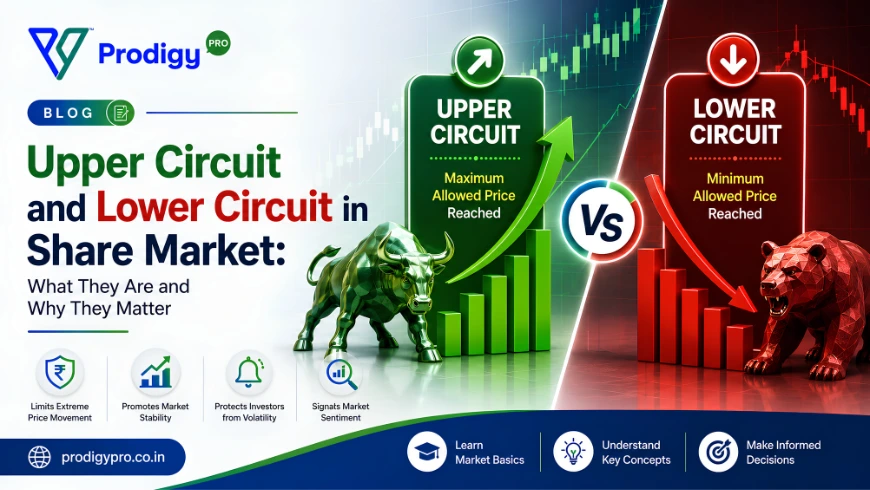
An upper circuit is the highest price a stock is allowed to hit in a single trading session. A lower circuit is the lowest. Once either limit is reached, the exchange freezes trading in that stock for the rest of the day. These bands usually 5%, 10%, or 20% of the previous day’s closing price—exist for one reason: to stop panic and euphoria from sending a stock’s price completely off the rails.
If you’ve ever pulled up a stock chart and seen it “locked,” with no way to buy or sell, that’s exactly what happened. This is how the upper circuit and lower circuit mechanism helps keep stock prices from moving too sharply in a single session.
What Is an Upper Circuit?
An upper circuit kicks in when a stock’s price climbs to the maximum it’s allowed to move in that session. At that point, everyone left in the order book wants to buy — there’s simply no one willing to sell at that price anymore, so the exchange pauses trading.
You’ll usually see this after genuinely good news: a strong earnings report, a big new order win, some positive sector-wide development, or just a broader bull run pulling a stock along with it.
What Is a Lower Circuit?
A lower circuit is the lowest price a stock is allowed to fall to during a single trading session. Stock exchanges set this limit to prevent panic-driven crashes and excessive volatility. When a stock hits its lower circuit, no trades can happen below that price. If there are only sellers and no buyers at the circuit price, trading may halt until buyers emerge.
Stocks usually hit the lower circuit due to poor earnings, negative news, weak market sentiment, or heavy selling pressure. Circuit limits help maintain orderly trading and protect investors from extreme price swings.
Why Does the Exchange Even Bother With These Limits?
The stock market moves on emotion as much as on fundamentals. A single earnings call, a piece of global news, or even a rumour with zero substance can send a stock swinging wildly within minutes. Circuit limits sometimes called circuit breakers or price bands — exist to put the brakes on that.
In practice, they do a few things:
- Stop a stock from swinging to absurd extremes in one session
- Force a pause so investors aren’t reacting purely on adrenaline
- Make it harder for anyone to manipulate a thinly-traded stock
- Keep the broader financial system from getting destabilised by one runaway stock
It’s not unlike a speed limit on a highway it doesn’t stop every accident, but it keeps things from spiralling completely out of control.
How the Math Actually Works
Every stock listed on NSE or BSE gets assigned a circuit band based on how volatile it’s historically been and the category it falls into. The three most common bands you’ll come across are 5%, 10%, and 20% of the previous closing price.
Here’s a simple way to picture it: say a stock closed yesterday at ₹200, and it’s on a 10% band.
- Its upper circuit today would be ₹220
- Its lower circuit would be ₹180
The moment the price touches either number, that’s it for the day — trading in that particular stock stops until the next session, unless the exchange decides to revise the band.
Note : there’s also a separate, market-wide version of this called a circuit breaker, which isn’t about one stock — it kicks in when major indices like the Sensex or Nifty fall sharply, and it pauses trading across the entire exchange, not just a single company.
Why Do Stocks Actually Hit These Circuits?
There’s rarely just one reason. A few of the usual suspects:
Rumors. Even unverified ones can send a stock flying in either direction, simply because traders react before they verify.
Low trading volume. A stock that doesn’t see much daily action can be moved dramatically by even a handful of large orders there just isn’t enough liquidity to absorb them smoothly.
Genuine company news. Great quarterly numbers or a big new contract can push a stock straight to its upper circuit. A scandal or a weak earnings report can do the opposite just as fast.
Overall market mood. When the broader market is bullish, momentum stocks tend to get dragged along for the ride. When it’s bearish or panicky, weaker names can get pulled down just as fast.
So How Does This Actually Help Investors?
It’s easy to think of upper circuit and lower circuit in the share market as just an exchange rule that gets in the way but they genuinely work in your favour more often than not.
They cap how much you can lose or gain on a single stock in one day, which helps limit the damage from any one bad session. A stock hitting its upper circuit again and again can be a real signal of strong momentum worth paying attention to and one that keeps hitting lower circuits is usually telling you something’s wrong before you find out the hard way.
There’s also a psychological benefit that doesn’t get talked about enough: the forced pause. When trading halts, you’re not staring at a live ticker tempting you into a rushed decision. That gap gives you a moment to think instead of reacting, making upper circuit and lower circuit in the share market an important safeguard for investors.
Are Circuit Limits Good or Bad for the Market?
Mostly good, honestly but not without a real downside.
On the plus side, they reduce panic, make it harder to manipulate prices, and give the whole system some breathing room during chaotic news cycles. The catch is what happens if you’re already holding a stock that’s locked in a lower circuit — you might simply not be able to sell, no matter how badly you want to exit. That’s a genuine liquidity trap, and it hits small-cap or thinly-traded stocks the hardest.
Long-term investors generally feel this less than short-term traders, since the whole issue only really bites when you need to get in or out right now.
Upper Circuit vs. Lower Circuit, Side by Side
| Metrics | Upper Circuit | Lower Circuit |
| What triggers it | Price hits the day’s maximum | Price hits the day’s minimum |
| Usual cause | Good news, strong demand, bull run | Bad news, panic selling, bear run |
| Order book looks like | All buyers, no sellers | All sellers, no buyers |
| What it means for you | Can’t buy more at that price | Can’t sell/exit at that price |
Conclusion
Upper circuit and lower circuit in the share market are basically the stock market’s traffic signals — they won’t eliminate volatility, but they slow it down just enough to stop things from spinning out of control. Whether you’re just getting started or you’ve been trading for years, understanding upper circuit and lower circuit in the share market gives you a clearer read on market sentiment and helps you avoid decisions made purely out of panic or excitement.
If you’re navigating volatile stocks or want help building a portfolio that can weather these swings, Our advisory team is happy to talk it through or explore mutual fund options directly through the Prodigy Pro app.
This article is for educational purposes only and does not constitute investment advice. Mutual fund investments are subject to market risks. Please read all scheme-related documents carefully before investing.