eDIS (Electronic Delivery Instruction Slip)
The stock market’s terminologies and technicalities are like an ocean. You won’t be able to know all of them overnight. Whether you are a trader or investor, you have definitely come across the term eDIS. Electronic Delivery Instruction Slip sounds a little bit complicated. Well, it’s not that. Here in this blog, we will break it down in the easiest way possible. So stay with us until the end.
What is eDIS?
Before knowing what eDIS is, you need to know about two depository bodies related to the stock market. One is NSDL (National Securities Depository Limited), and the other is CDSL (Central Depository Services Limited). These two depository bodies allow investors to sell their stocks without submitting physical paperwork. Now, coming to the main part, eDIS is an electronic authorised system, mandated by SEBI and implemented by CDSL/NSDL.
Previously, people used to fill out the physical delivery instructions (DIS slips) to sell any shares from their demat account.
The process was not only time-consuming but also risky, as people failed at transactions. Today, with the help of eDIS, selling shares takes only a few seconds.
Reasons Why Electronic Delivery Instruction Slip Is Important:
- No Power of Attorney (POA) Needed – There is no need to issue a Power of Attorney to your online broker. You can execute online sales transactions for the scrips held in your demat account by using the eDIS facility.
- Faster Trading – It delivers a smoother trading experience to traders. With the help of eDIS, you can sell almost instantly compared to the manual method.
- Ensuring transparency – To ensure transparency and protect investors from interest, eDIS is aligned with the regulatory standards set by SEBI (Securities and Exchange Board of India).
- Reliable – No matter where you are or what you are doing, you can do the transaction in just a few clicks.
- Double Layer Security – When you sell any share on any digital platform, eDIS will ask for an OTP. Moreover, they follow other security protocols. In terms of avoiding unauthorised debits, eDIS just adds an extra layer of digital verification.
Steps to Use Electronic Delivery Instruction Slip for Trading
Knowing the steps is an essential part, especially for beginners.
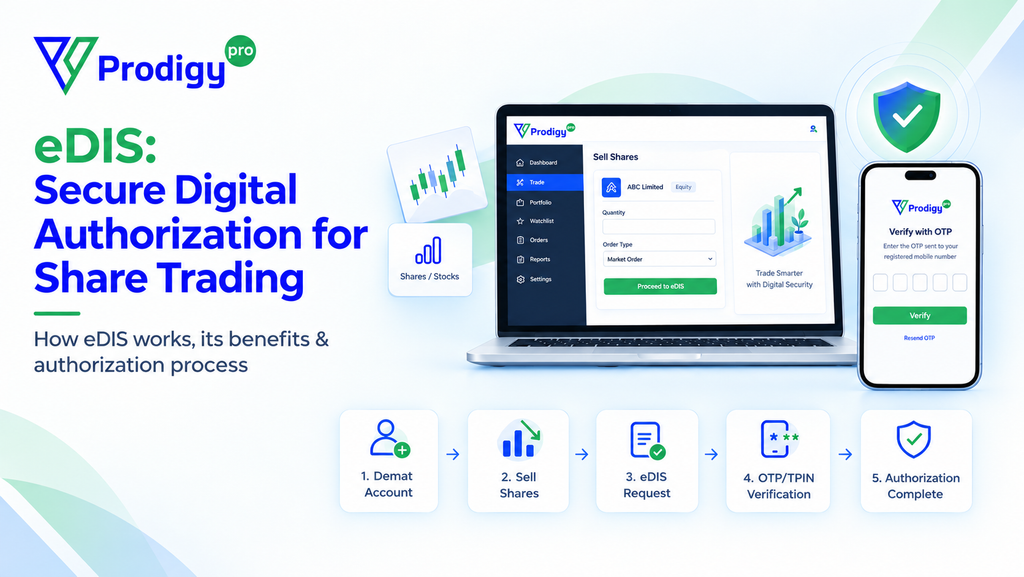
Step 1 – Link Your Accounts
If you want to use eDIS, make sure your demat account is linked to your trading account. Generally, when you open a demat account, the broker does all the required formalities to link your account.
Step 2 – Sell Shares
At this stage, you have to initiate the process of selling your shares. Simply log in to the trading platform, confirm the price and quantity, and place the order.
Step 3 – eDIS Request
After you place the order, your broker platform will directly trigger an eDIS request. At this stage, you will likely get a notification including a link directing you to the depository’s portal, such as CDSL or NSDL.
Step 4 – Fill In The Credential
Once you reach the portal, enter your login credentials and verify the transaction using the OTP. Remember, the OTP will be sent to your registered email ID or mobile number.
Step 5 – Completion
After verification, your shares will be debited from your demat account, and the sale will be done. The entire payment is credited to your account within a few working days.
Common Issues With eDIS
We all know the Electronic Delivery Instruction Slip is one of the most user-friendly systems; however, multiple traders and investors face trouble with the steps. Here are some common issues we have noticed:
- Many traders and investors face technical glitches; it’s pretty common. Nevertheless, clearing the browser cache and switching to another browser generally resolves the issue. However, if the glitch persists, try to contact your broker’s customer support.
- The authorisation link is time-limited. Try to complete the entire process quickly; otherwise, the session will expire.
- Always ensure your contact details are registered and up-to-date. Otherwise, not receiving an OTP is another very common problem. Sometimes, don’t panic; check the spam folders before contacting customer support.
- Beginners face trouble following the steps for eDIS. Additionally, the process might be a little different depending on which broker platform you are choosing.
Is eDIS Mandatory?
For most retail investors without a Power of Attorney (POA) or Demat Debit and Pledge Instruction (DDPI), eDIS is required to sell shares. If you’ve given your broker a POA or DDPI, you can skip it, as they can debit your account directly.
Also, Check – How Compound Interest Works
Wrapping Up
Whether you are an experienced trader or have just started your investment journey, understanding eDIS and its uses is essential. You will truly appreciate its importance when you make your first sale of shares. While the stock market can already be an uncertain space, embracing digital innovations like eDIS can make the process more convenient, seamless, and up-to-date.
Please share your thoughts on this post by leaving a reply in the comments section. Contact us via phone, WhatsApp, or email to learn more about mutual funds, or visit our website, Prodigy Pro. Alternatively, you can download the Prodigy Pro app to start investing today!
What happens if I enter the wrong TPIN?
Entering the wrong TPIN will stop you from authorising the transaction. If you type the incorrect password multiple times (more than three times) your TPIN might become invalid. To solve such conditions you can generate new TPIN as well.
Do I need to authorize every sales transaction with eDIS?
Yes, for every sale transaction, you need authorization via eDIS. Otherwise, you have to provide the POA (power of attorney) to the broker.
Are there any charges required for using eDIS?
No, there are no charges required for using eDIS.
Can I change my TPIN?
Yes, you can change your TPIN
Disclaimer – This article is for educational purposes only and does not intend to substitute expert guidance. Mutual fund investments are subject to market risks. Please read the scheme-related document carefully before investing.