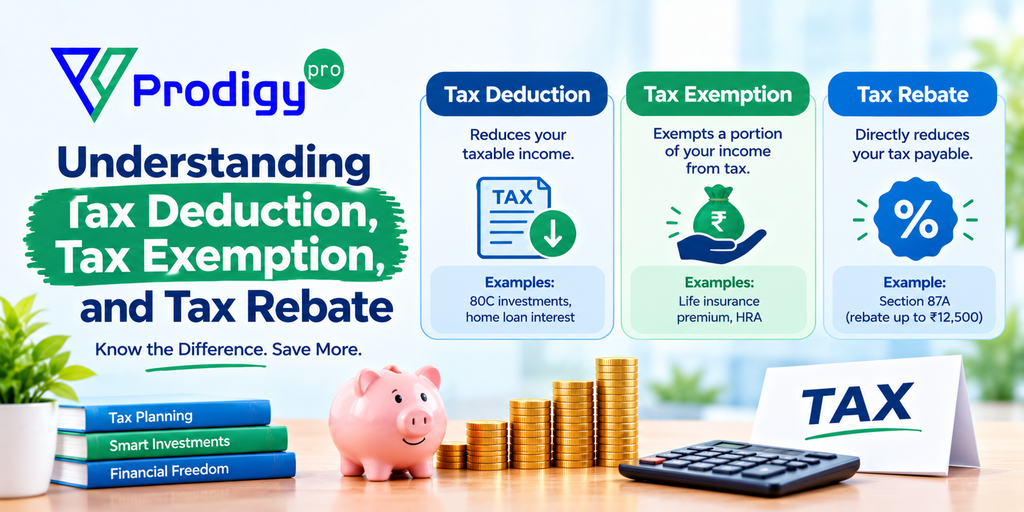
Tax deduction vs exemption vs rebate
Every taxpayer looks for ways to legally reduce their taxable income and minimise their tax liability. This is where tax deduction vs exemption vs rebate come into play. Nevertheless, these terms are often misunderstood or used interchangeably despite serving distinct purposes in income tax calculations. Understanding the difference between a deduction and an exemption, along with how a tax rebate works, is essential for efficient tax planning.
In this blog, we will break down these concepts in simple terms, explain how they differ, and explore how you can use them to make informed tax-saving decisions.
What is a Tax Deduction?
A tax deduction is an amount that you can subtract from your gross total income, thereby reducing your taxable income. By lowering the taxable amount, it reduces the income on which tax is levied.
For example, if your yearly income is ₹10,00,000 and you deduct ₹1,50,000 under Section 80C deductions, your taxable income falls to ₹8,50,000.
A few of the most widely used tax-saving investments entitled to income tax deduction are:
- Investment in ELSS (Equity Linked Savings Scheme)
- Premium paid for life insurance
- Contribution to provident fund
- Repayment of home loan principal
Therefore, deductions are one of the best tax-saving avenues for taxpayers.
What is a Tax Exemption?
A tax exemption permits a fraction of your income to be exempted entirely from taxation. This income is not added to your gross total income for tax purposes. Income tax exemption is normally provided on particular incomes, allowances, or perks.
For instance:
House Rent Allowance exemption permits salaried employees to partially or totally exempt their HRA paid by their employer.
Agricultural income is totally exempt under Indian taxation.
Some government employee gratuities and benefits are exempt.
Exemptions of tax in India are very useful for salaried individuals, freelancers, and business persons as well.
What is a Tax Rebate?
A rebate given in the form of tax is a facility that directly lowers the final amount of tax payable. It is not a decrease in income but in tax liability itself, eg., Section 87A.
For FY 2024-25, if your post-deduction income is less than ₹7 lakh (under the new regime), you can avail a rebate of up to ₹25,000, leaving your net tax payable zero.
Hence, an income-tax rebate helps you reduce or eliminate your net tax outgo without altering your income.
Key Differences Between Deduction, Exemption, and Rebate
| Basis | Tax Deduction | Tax Exemption | Tax Rebate |
| Meaning | Reduction from gross income. | Specific income excluded from taxation. | Direct reduction in tax liability. |
| Applied to | Gross total income. | Specific income sources. | Final tax payable. |
| Objective | To reduce taxable income. | To exclude certain incomes. | To reduce the final tax bill. |
| Example | Section 80C Deductions. | House Rent Allowance exemption. | Section 87A rebate. |
Examples of Common Deductions, Exemptions, and Rebates
Deductions:
- Section 80C: PPF, NSC, ELSS, Life insurance.
- Section 80D: Medical insurance premiums.
- Section 24(b): Payment of home loan interest.
Exemptions:
- HRA received (subject to conditions).
- Leave Travel Allowance (LTA).
- Agricultural income.
Rebates:
- Section 87A rebate for salaries of up to ₹7 lakh in the new regime.
- Rebate for specific individuals such as senior citizens in special situations.
Making the best use of these can help cut your tax liability substantially.
Tools to Maximise Tax Savings
Effective use of deductions, exemptions, and rebates can significantly reduce your tax burden. Here are some practical income-tax tips:
- Invest in schemes that are eligible for claiming tax deductions under the Income Tax Act, such as 80C and 80D.
- Claim the House Rent Allowance exemption if you are renting.
- Claim the Section 87A rebate if you are eligible.
- Seek outlesser-known tax-saving investments such as the National Pension System (NPS).
- Use legit tax-planning techniques, such as income splitting with family members in lower tax brackets (where it is legally permitted).
Section 80C Deductions
Section 80C deductions are one of the most widely used tax-saving provisions. The maximum limit is ₹1,50,000 per financial year.
Eligible investments and expenses are:
- Public Provident Fund (PPF)
- Employee Provident Fund (EPF)
- Life Insurance Premium
- Sukanya Samriddhi Yojana
- Home Loan Principal Repayment
Applying Section 80C deductions is one of the most effective methods to minimize taxable income.
House Rent Allowance (HRA) Exemption
If you are a salaried person who gets HRA as a component of salary, you can avail House Rent Allowance exemption under Section 10(13A). The exemption is on:
- Actual HRA received.
- 50% of salary if residing in metro cities (40% for others).
- Rent paid minus 10% of salary.
Availing this exemption can help decrease your taxable salary substantially and improve your tax saving alternatives.
Section 87A Rebate
Section 87A rebate is an important relief for middle-class taxpayers.
Eligibility criteria:
- Resident individual.
- Net taxable income after allowances must not be more than ₹7 lakh in the new regime.
- Maximum rebate permissible: ₹25,000.
This means that if your final tax payable is ₹25,000 or less, it will be reduced to zero after claiming the rebate.
Final Thoughts
Knowledge of the mechanism of tax deduction, tax exemption, and tax rebate is crucial to optimum financial planning. Effective utilisation of these tools for tax savings will help you maximise your income, make wiser investments, and significantly reduce tax.
Please share your thoughts on this post by leaving a reply in the comments section. Contact us via Phone, WhatsApp, or Email to learn more about mutual funds, or visit our website https://bfccapital.com/ .
Alternatively, you can download the Prodigy Pro app to start investing today!
Disclaimer – This article is for educational purposes only and does not intend to substitute expert guidance. Mutual fund investments are subject to market risks. Please read the scheme-related document carefully before investing.
FAQs
1. What is the principal difference between a tax deduction and a tax exemption?
A tax deduction lowers your overall taxable income, whereas a tax exemption eliminates the taxation of certain income altogether.
2. How much can I claim under Section 80C deductions?
You can claim up to ₹1.5 lakh annually under Section 80C by investing in instruments such as PPF, ELSS, and insurance.
3. Who can benefit from the Section 87A rebate?
Resident persons with a taxable income of up to ₹7 lakh can avail of the rebate under Section 87A that can bring down their tax liability to zero.
4. Which are the best tax saving investments for a salaried employee?
PPF, ELSS mutual funds, NPS, life insurance policies, and home loan are the best tax saving investments.
5. Do I get both deductions and exemptions in the same year?
Yes, you can avail both deductions (such as 80C) and exemptions (such as HRA) simultaneously to get the best tax savings.