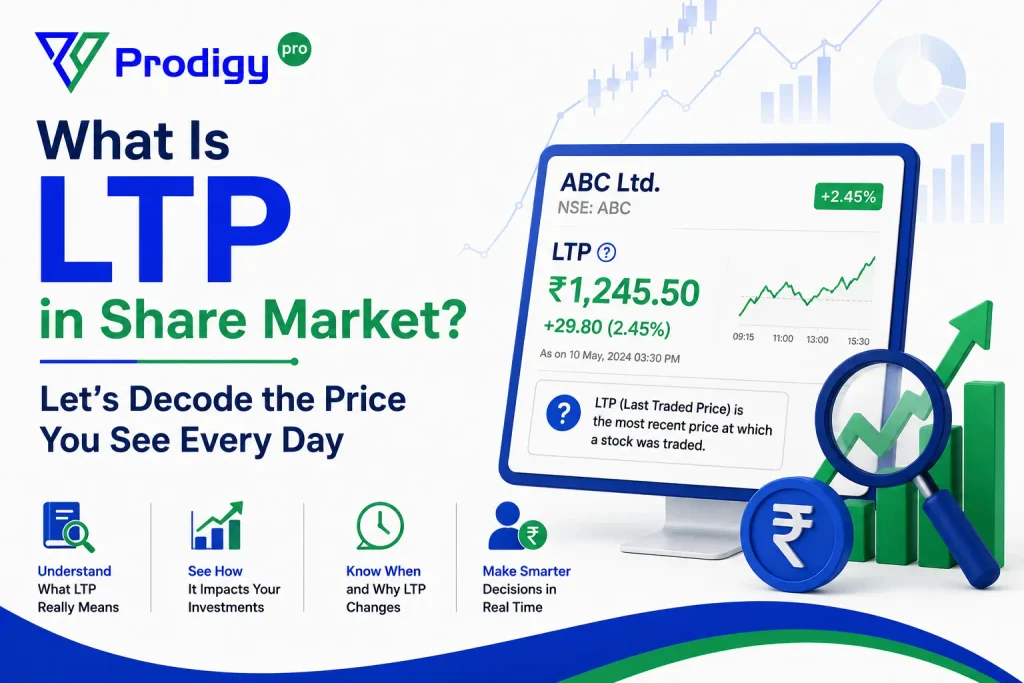
Introduction to LTP in Share Market
If you’ve ever opened your trading app, stared at a stock price, and thought,
“Okay… but what exactly is this number?”
You’re not alone.
That number you keep seeing change by the second is called LTP; it LTP stands for Last Traded Price, and understanding it is crucial for every investor, as it reflects the latest price at which a stock has actually been traded.
It looks simple, sounds technical, and quietly plays a bigger role in your investing decisions than you might realise.
Let’s break it down calmly, without pressure, jargon, or pretending everyone should already know this.
Understanding LTP in the Share Market
LTP is the price at which a stock was most recently bought and sold on the exchange, the price at which a stock was most recently bought and sold on the exchange.
That’s it.
No hidden math.
No prediction.
No opinion.
If the most recent trade in a stock happened at ₹412, then ₹412 becomes the LTP in share market until another trade takes place. Every time a new buyer and seller complete a transaction, the LTP updates instantly.
Think of it like the last item sold at an auction. Whatever price the hammer came down on last, that becomes the current reference price.
Why LTP Matters For Every Share Market Investor
You might be thinking,
“I’m not an intraday trader. Why should I care?”
Fair question.
Here’s the thing:
Last Traded Price is one of the most honest prices you’ll ever see in the market.
It reflects a real transaction between a real buyer and a real seller.
Not a guess.
Not a model.
Not a forecast.
That makes it useful in a few everyday ways.
1. It Shows What the Market Is Actually Willing to Pay
If a stock’s LTP is steadily moving up, it usually means buyers are comfortable paying more.
If it’s slipping, sellers might be more eager than buyers.
It doesn’t tell you why—it simply tells you what’s happening in the market.
And sometimes, that’s enough context to pause, observe, or dig deeper before making an investment decision.
Understanding the meaning of LTP helps investors identify how buyers and sellers are reacting at any given moment.
2. It Helps You Place Smarter Orders
Suppose a stock’s LTP is ₹250.
If you place a buy order at ₹260, you’re basically saying,
“I’m okay paying more than what others just paid.”
If you place it at ₹240, you’re saying,
“I’ll wait—I’m only interested if it comes cheaper.”
Without LTP, you’d be placing orders almost blindly.
For both beginners and experienced investors, monitoring the LTP in share market helps in placing more realistic buy and sell orders.
3. It Hints at Liquidity
Stocks where LTP changes every second usually have lots of buyers and sellers.
That’s liquidity.
Stocks where LTP doesn’t move for hours often indicate lower trading activity.
That isn’t necessarily bad—it simply tells you fewer trades are taking place, something worth considering if you may need to buy or sell quickly in the future.
A Quick Real-World Example of LTP in Share Market (Because This Helps)
Imagine you’re buying a used car.
The last buyer bought a similar car for ₹5 lakh yesterday. That becomes the reference point today.
Now:
- If demand increases, the next sale might happen at ₹5.2 lakh.
- If demand drops, maybe ₹4.8 lakh.
That last sale price keeps shifting based on who’s willing to buy and who’s willing to sell.
The stock market works the same way—just faster, louder, and with more numbers flashing on your screen. Understanding LTP in share market becomes much easier when you think of it as the most recent agreed price between a buyer and seller.
LTP vs Closing Price (This Confuses Almost Everyone)
This is worth slowing down for.
One of the most common questions investors ask after learning of LTP is whether Last Traded Price and the Closing Price are the same.
The answer is no.
- LTP is the price of the last trade that happened.
- Closing Price is calculated at the end of the trading day.
The Closing Price isn’t always the same as the Last Traded Price. It’s often calculated using trades near market close, helping avoid unusual last-minute price movements from affecting the day’s official closing value.
So if you’re checking prices after market hours, don’t be surprised if:
- LTP says one thing.
- Closing Price says another.
Both are correct—they’re simply telling slightly different stories.
How Is LTP Calculated? (No Mystery Here)
There’s no formula.
No committee.
No opinion.
It works like this:
- A buyer places an order.
- A seller agrees to that price.
- The trade is executed.
- That price immediately becomes the new Last Traded Price.
Simple.
Almost boring.
Which is actually a good thing.
The market doesn’t care who you are.
It only cares whether both sides agreed on the same price.
This is exactly how LTP in share market is updated every second during market hours.
How Different Investors Use LTP
For Active or Intraday Traders
For active traders, LTP is everything.
It’s the pulse.
The heartbeat.
The constant update that tells them whether momentum is building or fading.
They watch it like a hawk because even small changes in LTP can influence short-term trading decisions.
For Long-Term Investors
For long-term investors, Last Traded Price is more like a temperature check.
You don’t panic because it changed today.
You notice patterns over time.
You care more about the business, but LTP in share market tells you how the market currently feels about it.
If you’re investing for years, don’t let daily LTP movements bully you into decisions.
What LTP Does Not Tell You (Important)
This is where many rookie investors slip.
Last Traded Price:
- Does not predict future prices.
- Does not tell you whether a stock is cheap or expensive.
- Does not explain why a price moved.
It only tells you what just happened.
Treat it like a rear-view mirror—not a crystal ball.
Knowing LTP in share market is useful, but it should always be supported by research, company fundamentals, and market analysis.
Common Beginner Mistake (And How to Avoid It)
Mistake:
“The stock is going up, LTP is rising—I should buy now.”
Pause.
Ask yourself instead:
- Why is the stock going up?
- Has something changed in the company’s business?
- Am I investing based on research or simply reacting to price movement?
LTP is information.
Your judgment is what turns that information into a smart investment decision.
Key Investor Takeaways (Save This Part)
- LTP Full Form is Last Traded Price.
- LTP refers to the latest executed trading price of a stock.
- LTP in share market changes whenever a new trade takes place.
- Last Traded Price reflects real-time market activity—not future potential.
- Rising or falling LTP alone doesn’t automatically mean “buy” or “sell.”
- For beginners, LTP should guide your understanding of the market—not drive your investment decisions.
Understanding this one concept already puts you ahead of many first-time investors.
Also Read: Interest Rate Risk
One Last Thought Before You Close This Tab
Last Traded Price is not scary.
It’s not complicated.
It’s simply the latest traded price doing its job.
Once you understand what LTP is, stop expecting it to predict the future and start using it to understand the present.
That’s when investing becomes calmer.
More deliberate.
Less reactive.
And that’s where better investment decisions usually begin.
Please share your thoughts on this post by leaving a reply in the comments section. Contact us via phone, WhatsApp, or email to learn more about mutual funds, or visit our website. Alternatively, you can download the Prodigy Pro app to start investing today!
What is LTP Full Form?
The LTP Full Form is Last Traded Price.
What is LTP Meaning in Share Market?
LTP meaning refers to the latest executed trading price agreed upon by a buyer and seller.
Is LTP the Price I’ll Always Get If I Buy or Sell?
Not necessarily.
Markets move quickly.
You might get the same price, slightly better, or slightly worse depending on demand, supply, and market timing.
Is LTP Useful Even If I Invest Through Mutual Funds?
Indirectly, yes. Understanding market prices helps you better grasp NAV movements and market behavior.