
Let me ask you something: what would you do with Rs 4 lakhs if it just showed up in your account one fine morning?
A lumpsum investment calculator can help you see how a one-time investment could potentially grow over the years. So, instead of wondering what Rs 1 lakh could become in the future, let’s look at a real example.
Would you finally take that long-overdue vacation with your family? Or maybe use it as a down payment for a car you’ve been eyeing? Or perhaps just enjoy the peace of mind that comes from knowing you’ve got a tidy little financial cushion?
Well, here’s the thing — you don’t need to win a lottery to make that happen. You just need to plant one financial seed, let it grow, and watch it blossom.
If that sounds surprising, here’s how a Rs 1 lakh one-time investment could potentially grow to Rs 4.04 lakh in 10 years. No complex strategies, no Wall Street jargon. Just a simple, well-timed move that anyone — yes, anyone — can do.
Give Your Lump-Sum Investment Time to Grow
Imagine you receive a Rs 1 lakh bonus at work.
You could spend it on a new gadget, a fancy dinner, a weekend getaway, or that piece of furniture you’ve been eyeing for months.
You could do numerous things, but what if you decide to invest that money? That’s where lump-sum investing comes into the picture.
The concept of lump-sum investing is very simple. Unlike a Systematic Investment Plan (SIP), where you invest a fixed amount at regular intervals, a lump-sum investment involves investing a one-time amount.
And the idea of investing that Rs 1 lakh bonus isn’t bad either; after all, you don’t need the money urgently—so it could sit and grow.
Moreover, for someone who has received a bonus, tax refund, gift, or simply has some surplus money lying around, lump-sum investing can be an option worth considering—provided it fits their financial goals, risk appetite, and time horizon.
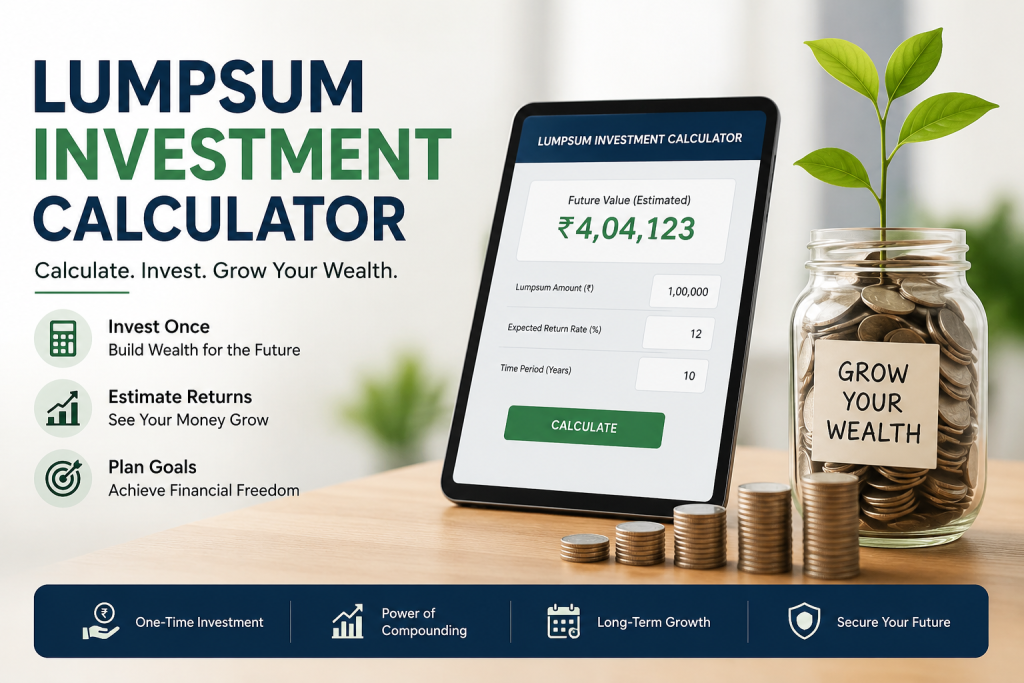
To understand how much that Rs 1 lakh could potentially grow, you can use a LumpSum investment Calculator.
Let’s say you enter:
- Initial investment: Rs 1,00,000
- Investment period: 10 years
- Assumed annual return: 15%
The estimated future value comes to approximately Rs 4.04 lakh.
Of course, the 15% figure is only an assumption for illustration. Mutual fund returns are market-linked and are not guaranteed.
The Magic of Compounding — Your Money’s Best Friend
Let’s take a moment to talk about the real hero of this story: compounding.
You see, compounding is like planting a tree. You water it (your initial investment), and over time, it starts to grow on its own. The returns you earn each year aren’t just added to your original investment — they start earning returns too. So, the longer you leave your money alone, the bigger the tree gets.
And just like trees don’t grow overnight, neither does your investment. But given time, the growth becomes surprisingly rapid.
In this case, Rs 1 lakh grew to Rs 4.04 lakhs over 10 years. That’s a potential gain of more than Rs 3 lakh. The example highlights how time and compounding can work in an investor’s favour without requiring daily trading or attempts to time the market.
What Makes Lump Sum Investment so Special?
You might be thinking — why would someone invest a lump sum instead of a monthly SIP?
Great question. SIPs are fantastic, but lump sum investments have their own charm:
- Ideal for windfalls: Got a bonus, tax refund, or gift? Instead of letting it sit idle, you invest it and let time do the work.
- One and done: No need to remember monthly payments or auto-debits. Just invest and be patient.
How Different Investors Could Use a Lump-Sum
Let us tell you about a few people who used this exact approach — no fancy strategies, no market wizardry.
1. Ramesh’s Retirement Boost
Ramesh retired early at 50. He received a lump sum from his company. Instead of putting it all in a fixed deposit (which his bank strongly encouraged), he invested Rs 1 lakh in a mutual fund as per his financial objectives. 10 years later, it was worth over Rs 4 lakh — helping fund his granddaughter’s college education.
2. Priya’s Wedding Fund
Priya wanted to contribute to her own wedding but didn’t know how. She invested Rs 1 lakh she had saved during her internship years. A decade later, that fund was the cherry on top of a beautiful wedding celebration.
But What If the Market Falls?
Great point. What if you invest a lump sum and then the market drops?
Here’s the truth: short-term fluctuations will happen. With a 10-year investment horizon, investors may have more time to ride out short-term market volatility. However, a longer horizon does not eliminate market risk or guarantee returns. In fact, many investors find that those market dips are opportunities in disguise — because your money is already in and positioned to benefit from the eventual rise.
Think of it like this: you’re on a long train ride. The scenery might not be beautiful the whole way, but the destination is worth it.
A Simple Action Plan to Start Your Lump-Sum Investment
So, now that you know what’s possible, let’s talk about how to actually do it, which honestly is easier than you think.
Step 1: Know Your Goals
What are you saving for? A home? Travel? Education? Retirement? Knowing your “why” helps pick the right fund.
Step 2: Use the Prodigy Pro Lumpsum investment Calculator
Just head to their calculator, select the lump sum tab, and play with numbers. You’ll see exactly how much your money can grow over time.
Step 3: Pick a Mutual Fund
Stick with something aligned with your goals — long-term equity mutual funds are a popular choice for a 10-year horizon.
Step 4: Invest and Forget
Seriously. Don’t check it daily. Don’t panic during market dips. Just trust the process.
Final Thoughts
If you’re sitting on Rs 1 lakh right now and wondering what to do with it, consider investing it: every year you wait is a year you miss out on potential growth. That’s not just theoretical — it’s measurable.
Let’s say you waited 2 years before investing that Rs 1 lakh. With the same, let’s say, 15% return, instead of Rs 4.04 lakhs, you’d end up with only Rs 3.05 lakhs in 8 years.
That’s almost Rs 1 lakh of lost growth because you waited for absolutely no good reason.
Sometimes, all it takes is one decision to change how your future looks.
So… what’s stopping you?
Please share your thoughts on this post by leaving a reply in the comments section. Contact us via phone, WhatsApp, or email to learn more about mutual funds, or visit our website. Alternatively, you can download the Prodigy Pro app to start investing today!
What if the market falls after I invest?
Short-term falls happen. Over 8–10 years, markets usually recover and reward patience.
Do I need deep knowledge to start?
Not at all. A clear goal and long-term mindset are enough.
Is lump sum better than SIP?
Neither is better. Lump sum works well for bonuses or savings; SIPs suit regular income.
When will I see real growth?
Usually after 7–10 years, when compounding really kicks in.
Disclaimer – This article is for educational purposes only and does not intend to substitute expert guidance. Mutual fund investments are subject to market risks. Please read the scheme-related document carefully before investing.