
Is a Cheaper Mutual Fund Always Better?
We are all naturally attracted to cheap things.
A lower price feels like a better deal. But deep down, we also know this truth: not everything cheap is good.
Yet when it comes to mutual funds, many investors still fall into this trap.
There is a common belief that if a mutual fund has a lower expense ratio, it must automatically be a better fund.
But is that really how it works?
With SEBI’s recent overhaul of mutual fund expense regulations, this question has become more important than ever. Because what SEBI has done is not just tweak a rule—it has reset how mutual fund costs are structured, displayed, and understood.
If investors don’t understand this change properly, they may end up comparing funds incorrectly and drawing the wrong conclusions.
Let’s decode what SEBI has changed, why it matters, and what it actually means for retail investors.
Why Expense Ratios Were Always Confusing
Earlier, investors were shown just one number: Total Expense Ratio (TER).
This single number included everything:
- Fund management fees
- Distributor commissions
- Operational costs
- Brokerage and trading expenses
- Regulatory charges
- Even taxes like GST, STT, and stamp duty
The problem was simple:
Investors could see the final cost but had no idea where their money was actually going.
Was the fund house charging high fees?
Or were statutory market charges inflating the number?
There was no clarity.
Two funds with the same TER could have completely different internal cost structures, yet they looked identical on paper.
SEBI decided it was time to fix this.
SEBI’s Two Big Structural Changes
SEBI introduced two major structural reforms in mutual fund expenses.
1. Introduction of Base Expense Ratio (BER)
SEBI has introduced a new concept called Base Expense Ratio (BER).
BER represents the core cost of running a mutual fund—the part that the fund house actually controls.
It includes:
- Fund management fees
- Operational expenses
- Distribution-related costs (within defined limits)
It excludes:
- Securities Transaction Tax (STT)
- GST
- Stamp duty
- Exchange charges
- SEBI fees
In simple terms, BER tells you what you are paying for fund management skill and structure.
2. Statutory Charges Taken Outside Expense Limits
Earlier, statutory and regulatory charges were bundled inside TER.
Now, they are charged separately, outside BER.
This means:
- Investors can clearly see what part of the cost goes to the fund house
- And what part goes to the government or market infrastructure
Under the new framework:
Total Expense Ratio = Base Expense Ratio + Brokerage + Regulatory charges + Statutory taxes
This is not just a presentation change.
It completely changes how investors should interpret costs.
What SEBI Is Really Trying to Achieve
Contrary to popular headlines, SEBI’s objective is not just to make mutual funds cheaper.
The real goal is transparency.
Earlier, investors saw only the final TER number but never understood how it was constructed.
Now, expenses are unbundled.
For the first time, investors can clearly distinguish:
- What costs are controllable by the fund house
- What costs are unavoidable statutory levies
SEBI wants investors to ask a sharper question:
Am I paying for genuine investment skill, or just for structure and churn?
Revised Expense Ceilings: Tighter Than Before
Along with restructuring, SEBI has also tightened expense limits.
The principle remains the same:
The larger the fund size, the lower the expense allowed.
But the limits are now stricter.
Revised Base Expense Ratio Limits for Equity Funds.
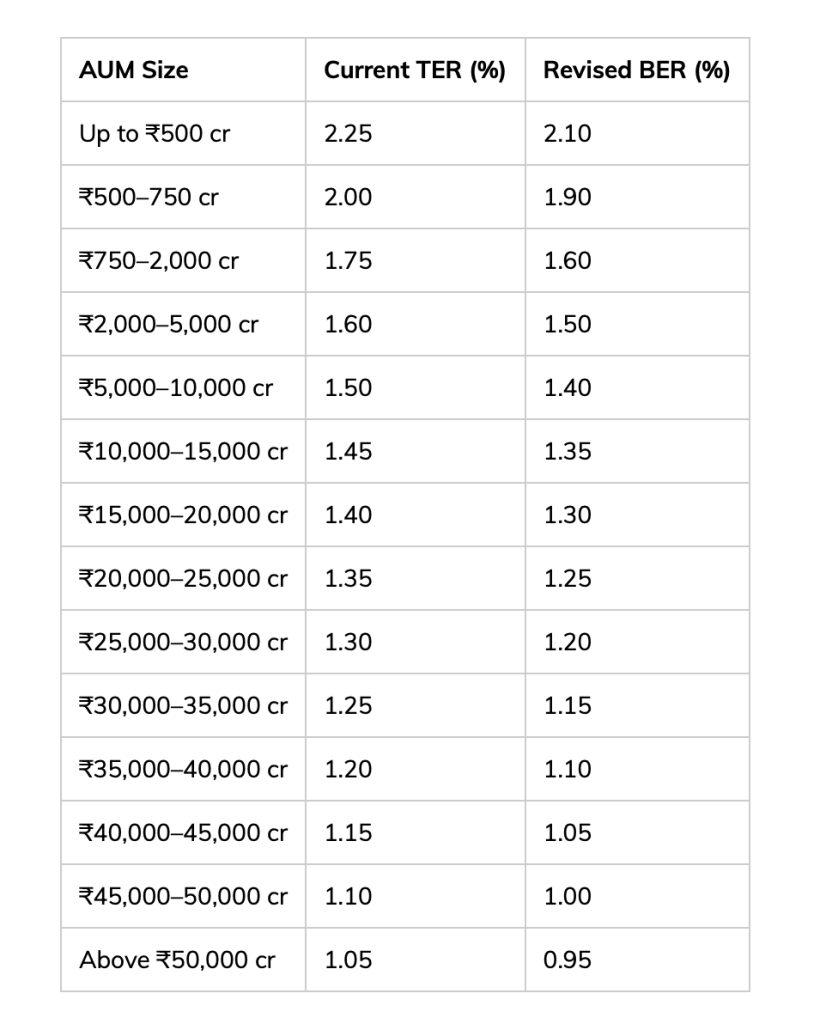
These reductions apply across all equity categories.
Non-Equity, Passive, and Closed-Ended Schemes
- Non-equity schemes now have BER limits ranging from 0.70% to 1.85%, depending on AUM size.
- Index funds and ETFs see a reduction from 1% to 0.90%.
- Closed-ended schemes also have reduced base expense limits.
Silent but Powerful Change: Brokerage Cost Rationalisation
One of the most understated yet impactful changes is in brokerage caps.
- Cash market brokerage is capped at 6 basis points, down from an effective 8.59 bps earlier.
- Derivative transaction brokerage is capped at 2 basis points, down from 3.89 bps.
This directly impacts:
- High churn strategies
- Excessive trading
- Short-term portfolio flipping
Funds that rely heavily on trading will now find it harder to justify those costs.
Efficiency will matter more than activity.
The Big Question: Will Investors Actually Save Money?
Here’s the honest answer.
Yes, headline expense ratios will look lower.
But total investor cost may not fall dramatically.
Earlier, statutory levies were hidden inside TER.
Now, they are shown separately.
Experts estimate real savings of around 6–8 basis points, mainly due to:
- Lower brokerage caps
- Removal of certain load-linked expenses
These savings are real—but not game-changing.
Your fund hasn’t suddenly become dramatically cheaper.
Your returns won’t change overnight.
The Biggest Mistake Investors Must Avoid
This change introduces a new trap.
Do not compare mutual funds only on the Base Expense Ratio.
BER is only one component.
The actual cost remains the Total Expense Ratio, which includes:
- BER
- Brokerage
- Regulatory and statutory charges
If investors start choosing funds only because they have a lower BER, they may reach completely wrong conclusions.
The right approach is to understand both BER and TER together.
Does This Change How You Should Select Funds?
Not really.
Experts agree that fund selection fundamentals remain unchanged.
Long-term investors should still focus on:
- Consistency of performance
- Fund manager quality
- Risk control and downside management
- Volatility handling
A 5–10 basis point cost difference does not materially impact long-term returns—especially if fund selection itself is flawed.
A cheap but poorly managed fund is still a bad investment.
Who Is Actually Impacted the Most?
The immediate impact is not on investors, but on:
- Fund houses
- Brokers
Cash brokerage revenues could fall by 15–20%.
Derivative brokerage revenues may decline by 3–5%.
This is where SEBI’s reform bites the hardest.
Active vs Passive: Any Shift?
No major shift.
Passive funds were already operating in a low-cost environment.
Active funds do not suddenly become unattractive.
Trading costs were never the core differentiator—portfolio strategy is.
This regulation does not artificially tilt the debate in favour of passive funds.
Borrowing Flexibility for Index Funds and ETFs
SEBI has also streamlined borrowing rules for equity-oriented index funds and ETFs.
These funds are usually fully invested, which creates a challenge when:
- There’s a sudden redemption request
- Or a short-term investment opportunity arises
SEBI now allows limited intraday borrowing to:
- Manage liquidity mismatches
- Execute purchases
- Fulfil redemption needs
For example, if an opportunity appears mid-day but inflows arrive only at day-end, the fund can borrow temporarily to bridge the gap.
This improves operational efficiency, not speculation.
Also, check – ETFs vs Mutual Funds: Which Is Better for Young Investors?
Final Takeaway
Your mutual fund has not suddenly become cheap.
Your returns will not change overnight.
You don’t need to change your investment strategy.
What has changed is this:
- Costs are harder to hide
- Transparency has increased
- Efficiency will matter more going forward
This is a structural clean-up, not a marketing gimmick.And understanding it properly makes you a better-informed investor—which, in the long run, matters far more than saving a few basis points.
Please share your thoughts on this post by leaving a reply in the comments section. Contact us via phone, WhatsApp, or email to learn more about mutual funds, or visit our website. Alternatively, you can download the Prodigy Pro app to start investing today!